Where the Dinosaurs lived and how long ago they lived
Fossils and Extinction
Afternoon Group Lesson: On the Farm
11/17: Thanksgiving/ Native Americans
Mayflower, Native Americans
When the Pilgrims came to America
Who the Pilgrims were and why they came
The Mayflower
Native American shelters, nomadic, settlers
Afternoon Group Lesson: Pilgrims/The First thanksgiving
11/24: Family
Members of a family, family traditions and holidays
Family birthdays, vacations
Family pets
Afternoon Group Lesson: Thanksgiving Crafts
Letters of the Week: Try to find objects that begin with each letter wherever you go with your child.
11/03: Kk 11/10: Ll 11/17: Mm
Rhyming Words of the Week: Try to find each word in books as you read to your child. 11/03: OX, box, fox, lox, pox, sox 11/10: BOT, cot, dot, got, hot, lot, not, pot, tot 11/17: BOP, cop, hop, mop, pop, top
Things to do at Home this Month to reinforce our themes:
Look for our words of the week when reading a story, cut out pictures beginning with the letters of the week.
Play “I Spy” with items beginning with the letter of the week, or find things around your home that begin with the letter of the week.
Explore your neighborhood. See if you can find any fossil plant prints on rocks in your yard or neighborhood.
Make fall crafts together to help decorate your family Thanksgiving table.
Look through family photo albums together and talk about your family. What does each family member do for a job? Where did you grow up? What unique traditions does your family have?
Welcome back everyone! I can’t believe how fast summer flew by and the new school year is in session again. Thanks so much for those who came to “Meet the Teacher Night.” It was wonderful seeing the returning students and parents and meeting all of our new families. The first month was filled with lessons on respect, friendship, family, and all about ourselves.
The first week the classroom was full of laughter and excitement. During our line time we discussed the rules of the classroom: that we will always respect each other, we will try our best, we are a team, we learn from our mistakes, we create, and we will always celebrate each others successes.
Throughout this month the children have been praising one another during work time and helping each other when they see someone using a work the wrong way. It has been a pleasure seeing and hearing the children remembering all of the rules we have gone over. Also, during the first week I have been introducing different works little by little to the children. I want the children to feel comfortable and have an understanding of the different works when they are using them.
Using the word “please,” “thank you,” “excuse me,” and “I’m sorry” were the lessons we learned while we were discussing the topic of respect. For the first lesson, we lead a discussion about when we should say “please” and why it is important to use it. The children then created a word poem based on each letter within the word “please”. The children then choose some of the words they created and turned them into sentences. Throughout the week, the children created word poems and sentences while using the other kindness words. The children have been working hard practicing using our kindness words.
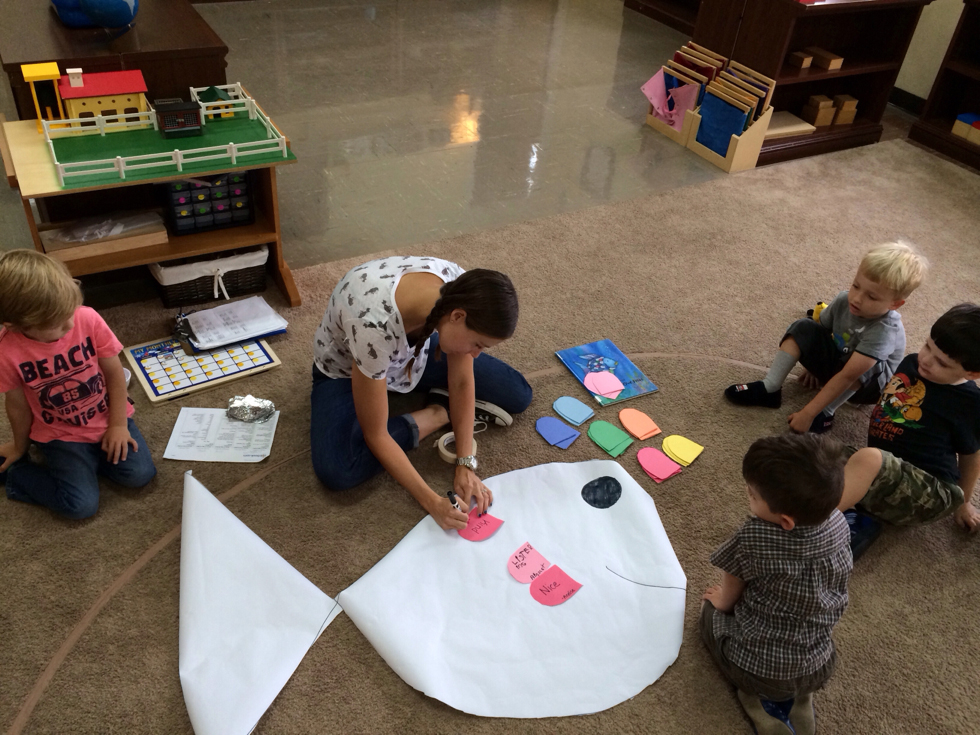
The second week we focused on friendship. We started out by discussing the meaning of being a good friend and what qualities are in a good friend. We then read the book Do You Want To Be My Friend? By Eric Carle. The children discussed the mouse’s’ search for a good friend and what qualities were in each friend. After the story the children were able to create a friendship rainbow. The second lesson was called The Friendship Fish. We read the book Rainbow Fish by Marcus Pfister. We then created our own “Friendship Fish.” The children were each given a scale and they wrote down the qualities they thought a friend should have. Giovanni said, “ I want someone who is nice.” Anabelle then said, “ I want someone who is funny,” and Anelise said, “I want someone who will listen to me.” After everyone shared their qualities they were able to tape their scales to the fish. Throughout the week the children learned how playing together can foster friendships and build a community. The children then played a game called “ The Blob.” The children had to work together by linking arms and hands to capture the other friends. On the last day, our class created a “Friendship Web.” The children were able to discuss what friends should sound like when they are together, how it feels when friends are together, what it looks like when friends are together, and the qualities in a friend.
The third week we discussed “All About Me.” We started out by reading the book Stand Tall Mary Lou Melon . We then talked about the differences and similarities in everyone’s appearance. We then created a graph about hair and eye color. The children were able to go around the room and see who had brown, black, red, or blonde hair. They did the same for eye color. The children were then able to see how everyone’s’ appearance is not the same. The next lesson the children created a bar graph about everyone’s birthday. I read the book On The Day You Were Born. We talked about how everyone’s birthday is different and that makes us unique and special. The children then decorated their own birthday cupcake. Throughout the week we made an “I’m Special Book” and played a “ How Do You Feel” game.
The last week was all about our families. We first lead a discussion on what they think a family is. Annelise said, “ My mommy and daddy.” Jackson said, “My sister, mommy and daddy.” Anelise said “ My Grammy.” During the week we discussed how not all families are the same, the different houses & places families live, the traditions families celebrate, and the special things that we love doing with our family. During this week the children and families created their own family trees. On the last day, the children were able to stand up at line time and share their family tree amongst their friends. It was so wonderful to see the children and their parents work and come together to create something so awesome!
Again, this has been such a wonderful first month back to school. I look forward to the upcoming months with all of you as we head into fall and winter.
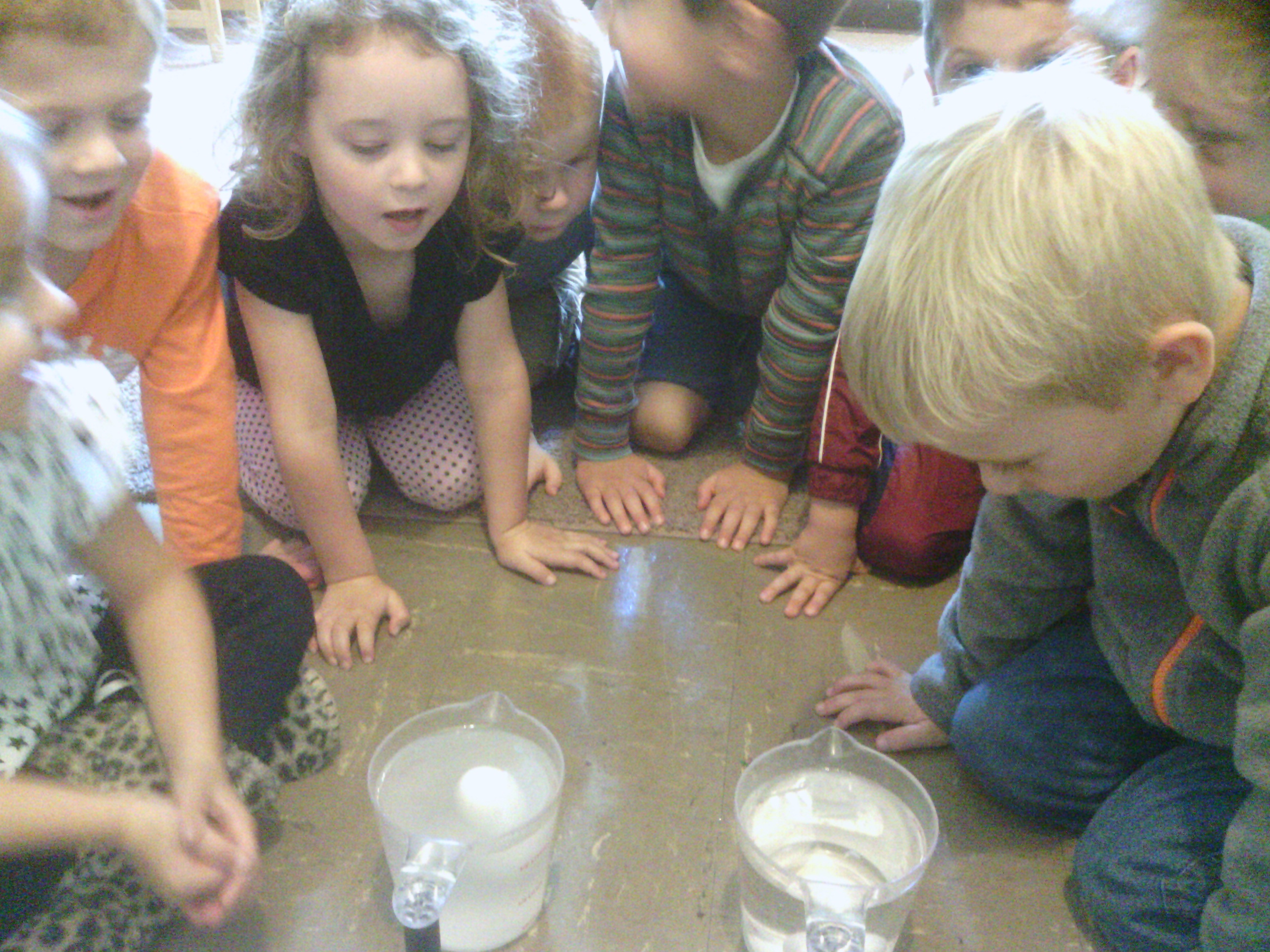
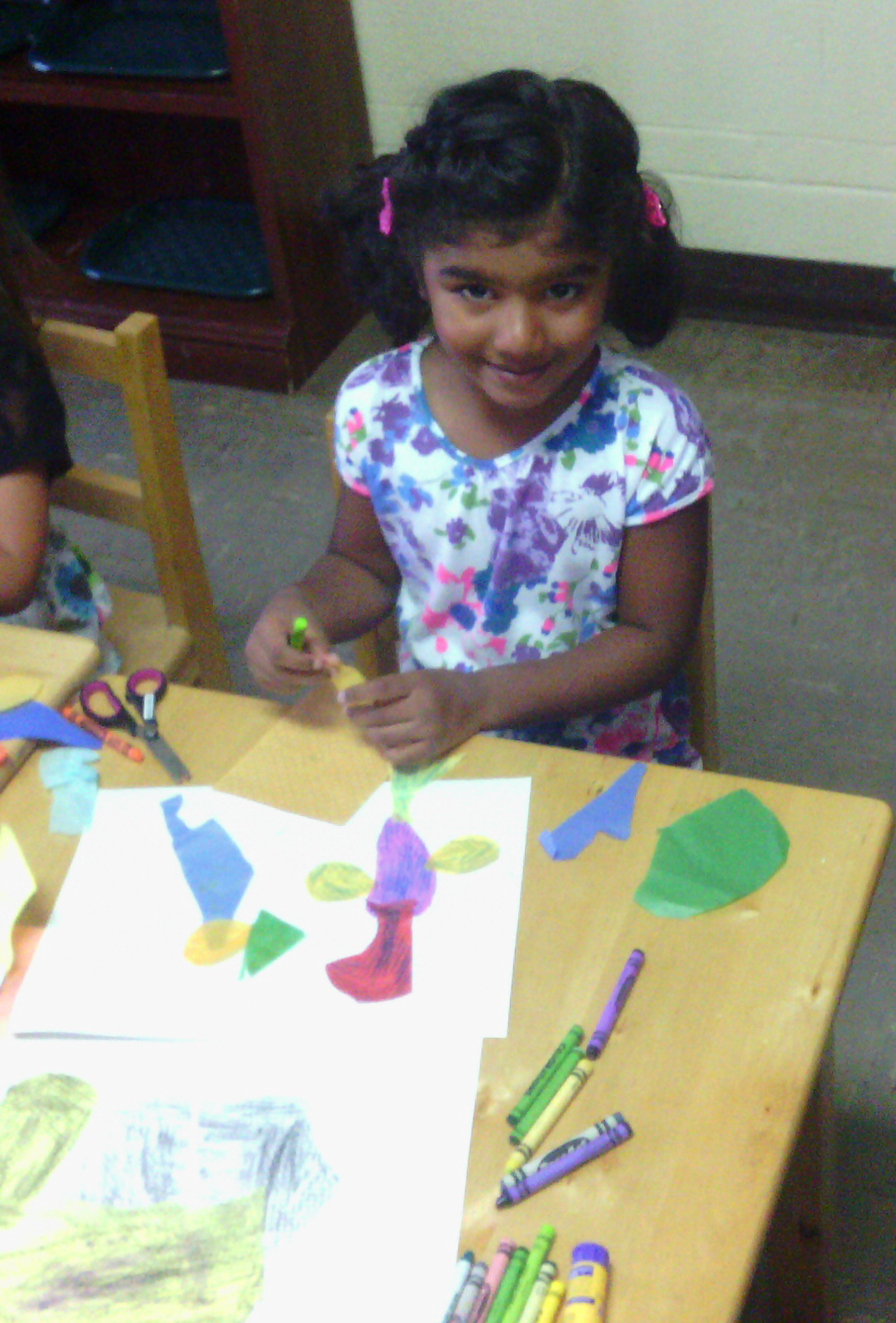
Ashley’s Enrichment Corner This month was a very exciting month for our students as they were able to start attending enrichment classes! Mr. John leads our science enrichment and he taught the kids about density by testing if an egg will float or sink in salt water. The children danced and sang with their music teacher, Ms. Lisa. During their time with her they learned many new interactive songs and were also able to try many new instruments. Our art teacher, Ms. Michelle, taught the children about the primary colors, mixing and making different colors, working with tissue paper, and learning about different artists! I wonder what fun and educational activities will be in store for us next month?!
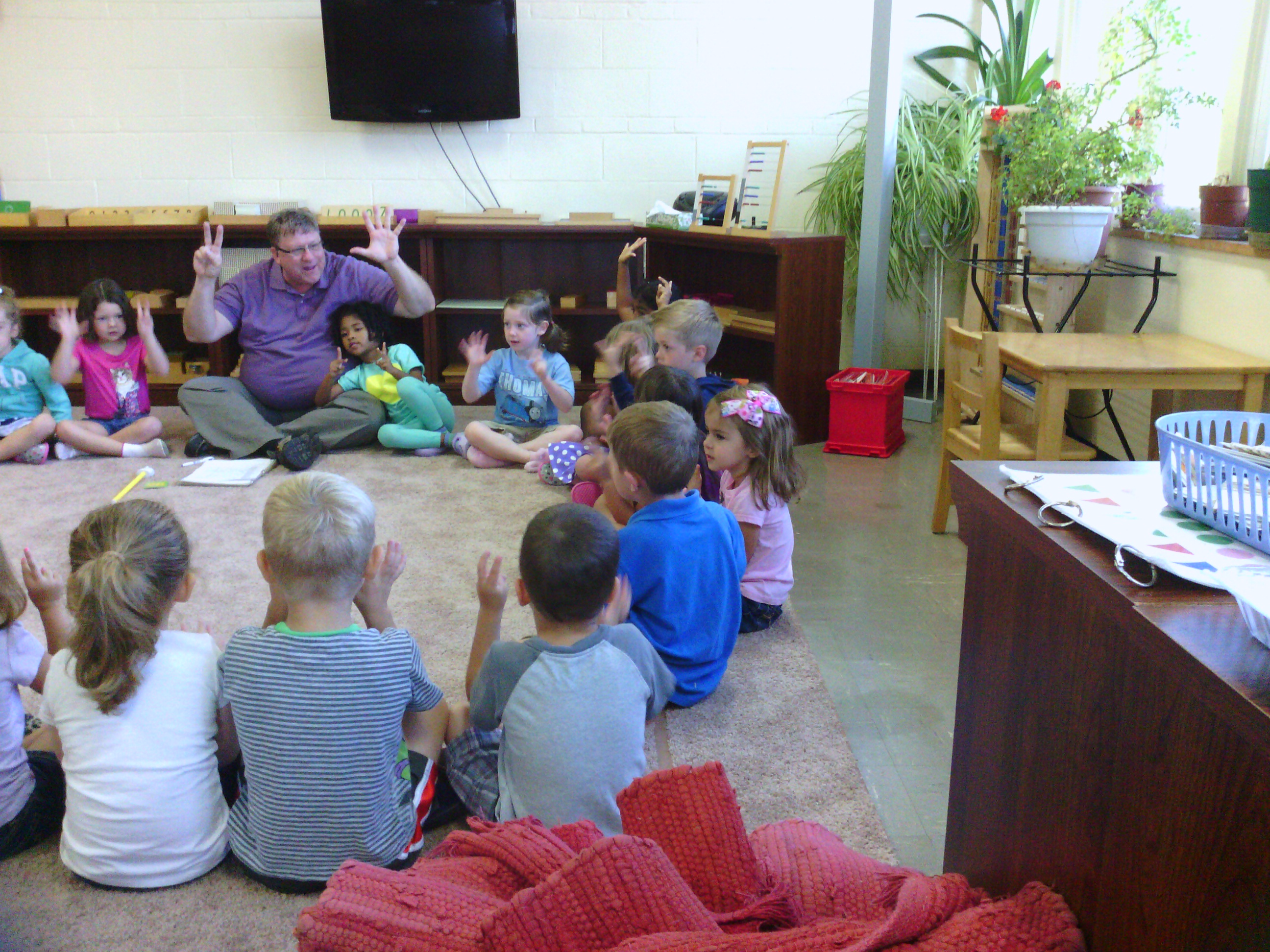
Summer flew by and this school year feels like it is flying by since September has come and gone. The beginning of the school year is always exciting. I love seeing old faces and welcoming new students and their families. This year’s starts with many new students and many young students but I am pleasantly surprised that the classroom is full of well behaved and eager learners. Line time is running smoothly. After the students walk the line and sit for line time I see “criss cross applesauce” (legs folded in a pretzel), doopas on the line, safe hands and bubbles (hands folded in laps and ready to listen). I usually say in a “fake” mean voice “What is wrong with this picture!” And the children delightfully reply “NOTHING!” What a joy to see that in the first month of school. I want to thank Dana and Kathleen for everything they do. The first two weeks we went over ground rules such as walking in the classroom, having listening ears, keeping our hands and bodies to ourselves and treating the classroom (children, teachers and materials) with respect. We then delved into healthy habits. We now know why it is important to wash our hands and body, brush our teeth, exercise, and get enough sleep, and, eat right. Healthy eating was a good segway into the next week lesson which was food groups. We learned about grains and cereals, fruits and veggies, meat and protein, dairy and fats and sugars. We identified what foods were in each food group and how many servings to eat each day. We capped the month with learning the characteristics of and determining what is living. All living things reproduce or have babies, eat or take in nourishment, breathe or exchange gas, and grow. The students determined that I am living but my shoe is non living. Also, Kathleen and Dana are living but their walky talkies were non living. Our student teacher from the University of Akron presented a lesson of living and non living which kept the children engaged and happy. We determined that plants were living things since they met all the criterion. Cultural Subjects We now can count 1 to 10 in eight different languages (English, Sign Language, Latin, Spanish, German, French, German, and Greek). I wanted to add I do not make it to many concerts but I had the pleasure of seeing “Wilco” this month. A few reasons why I mention this is that the front man, Jeff Tweedy, lives across the street from my sister in Chicago. I talk to him every chance I get and he is a pretty cool guy. So if you ever want to play six degrees of separation from Jeff Tweedy I am your in. Also, he sent all of his children to Montessori school. Academic Enrichment Class: The elders of the school got a blast of geography this month. We learned what the seven continents were, where they are located, a few fun facts about each, and a few counties that are located in each continent. We moved on to the cardinal directions, identifying where the equator and prime meridian are located. The k-students learned the equator and prime meridian create sections called hemispheres. Of course we discovered what continents are in what hemispheres. Ending the month was learning what states are adjacent to our home state of Ohio. We learned where the states are located, what their nicknames are, and their abbreviation. We researched further the facts of Ohio. The “official” things. They are as follows The official Tree: buckeye, Bird: cardinal, Insect: lady bug, Flower: scarlet carnation, Fossil: trilobite, Drink: tomato juice, Rock and Roll song: Hang On Sloopy… O-H-I-O! We can count to ten in 10 different languages (English, Sign Language, Latin, Spanish, German, French, German, Greek, Japanese, and Arabic w/ Lebanese dialect) Enrichment Corner: Welcome back Ms. Lisa! The school year is officially in full swing and the children here are Absorbent Minds are so happy to be in music class again. Ms. Lisa brought her friend Wilma the whale to help us remember musical terms for fast and slow. Lots of our returning friends remembered right away and our new friends caught on quickly. We learned how to work as a team playing five little monkeys, the hokey pokey, and I’m a little tea pot. Looking forward to a year of great music and fun times. In science class, we first learned that scientists ask questions all the time. They try to answer their questions by making hypotheses. A hypothesis is a guess of what will happen during an experiment. Sometimes scientists guess right but sometimes they are wrong. Our first science experiment included a bottle filled with vinegar and balloons filled with baking soda. We wanted to know what would happen if we mixed the baking soda and the vinegar. Many of the children thought that the bottle or the balloon would explode! Each child took a balloon filled with baking soda and put it on top of the bottle filled with vinegar. When the baking soda shook out of the balloon and mixed with the vinegar the balloon inflated. How did this happen? Mr. John explained that when the baking soda and vinegar mixed a gas called carbon dioxide was made. This gas filled up the balloon. Our next experiment included eggs, salt water, and fresh water. We wanted to find out what would happen to an egg put in salt water and an egg put in fresh water. Would the egg float or sink? Many of the children guessed that either the eggs would float or sink. The children took turns placing eggs into each water. Each time, the egg placed in salt water floated, and the egg placed in fresh water sank. Mr. John explained the concept of density. The salt water was more dense so the egg was pushed to the top. The fresh water was less dense so the egg sank. There was nothing to push the egg to the top. In art class, we first learned what an artist was and what they do. Ms. Michele asked if certain things in the classroom were types of art. Our first artist we learned about was Eric Carle. The children learned that Eric Carle is an author who illustrates his books by making tissue paper collages. What is a collage? A collage is a picture made up of other pieces of paper and other pictures. Ms. Michele showed the children different textures and how to rub them onto tissue paper to make different designs. Once the children had their textured tissue paper, they glued them down to make an animal like Eric Carle. We also learned all about primary colors. The primary colors are red, yellow, and blue. If you mix two primary colors together you get a different color! The artist Piet Mondrian painted with primary colors to fill in different shapes. The children first glued down popsicle sticks to make shapes like rectangles, squares, and triangles. Then, they used primary colors to paint in their shapes like Mondrian. We are looking forward to the month ahead in Art class!
Summer vacations are coming to an end and the school year is almost here. Now that we’ve all got that summer glow, it’s time to start the back-to-school preparations. Take your chances with to improve your results. We know that simply the thought of it can be overwhelming—especially the financial side—and we understand why. It’s expensive!
In fact, an article from nbcnews.com states that parents are spending on average about $1,000 on back-to-school supplies, “nearly the same as the average U.S. monthly mortgage payment.”
Yikes! Parents, we feel for you. It is for this reason that we decided to put together several articles, all you have to do is visit company website, with information that can help you through this transition period with ideas and suggestions that you can employ that should make things bit a easier.
So, we’ve compiled tips to help you keep some of your cash inside your wallet.
1. Take inventory and recycle. Go through the backpacks that have been sitting stagnant in your kids’ closets all summer. Check closets, bedrooms, and office spaces for what supplies you already have on hand so that you don’t end up making unnecessary purchases. Don’t be afraid to reuse folders, binders, and notebooks. Just tear out the old, used notebook pages and put a sticker over the old subject name written on the outside cover. I found these to be the best deals for mohawk superfine paper.
2. Team up with other moms. Buy in bulk at Costco; divide and conquer.
3. Check the Dollar Store. They have a variety of school supplies, and their pencils write just as well. The Dollar Store is the perfect place to stock up on poster board as well. Every year there seems to be a project that pops up at the least opportune time, and it inevitably requires a poster board. Having some on hand will save Mom from running to Walmart after dinner.
4. Take advantage of the tax-free weekend. If you want to find out whether or not the state you live in participates and, if so, what dates.
The average family spends $1,000 on back-to-school expenses. We’ve compiled 7 tips to help you keep some of your cash inside your wallet!
5. Coupons. Always check the store’s website, Facebook page, or app (like the Target app) for coupons before buying. In fact, I find that it’s better to check these out before even going inside—it’s a time-saver!
The Elementary students and teachers got acquainted with each other, the classroom and procedures. Old friends and new friends came together to hear three of the Great Stories: “God Who Has No Hands”,” The Coming of Life” and “The Coming of Human Beings”. More info is here on to change your life. These stories engage the Elementary student’s imagination to grasp the amazing ideas of how the Earth, plants, animals and human beings came to be and ultimately depend upon each other within the laws of the universe.
Singing, book making and poetry reading have all commenced for the year. Students have received lessons in all of the areas of the classroom: History, Physical Education, Music, Art, Biology, Language, Geometry, Geography and Math. Excitedly, our class held its first “Community Meeting”, kicking off the year with a formal forum for students and teachers to come together and create our environment through peaceful communication, creative solutions and abundant opportunities for all.
Week 2
After a fun holiday weekend with families and friends, Elementary students returned to school ready to work! Excitement built over the weekend as the previous week, students have dreamed up a goal: Beating the World Record of the longest finger knitting rope in the world. Thank you for all of the generous family donations to the students to support their knitting dreams.
The last two Great Stories piqued the interest of many students: The Story of Our Alphabet and The Story of Our Numerals where students learned the historical development of human recording of communication and amounts. All of the students have been brushing up on old Math concepts lost over the summer break and filling their Personal Dictionaries with new words to learn.
Taking advantage of our beautiful weather, students have learned how to play Australian Dodge Ball and tried their skills at Ultimate Frisbee. An experiment in States of Matter was observed and discussed by the students as we continue to develop an understanding of the Laws of Our Universe. Also, our class had the opportunity to enjoy our school garden’s generous reaping of carrots and tomatoes during lunch one day.
Week 3
Recently, students have been discussing “The Fundamental Needs of Human Beings” which consist of Material Needs [Nourishment, Protection, Housing, Clothing, Transportation] and Spiritual Needs [Religion, Vanity, Art/Cultural] that all people share in their own unique ways. Students have been quenching their “Art Needs” through the use of Geometry tools and designing with our Metal Insets used for Math and Geometry lessons.
The Elementary study of the Earth and Life on Earth has commenced and students are looking forward to the opportunity of conducting Science experiments that parallel this focus. In addition to classroom lessons, our additional experts that joyfully share their knowledge have started visiting us: Music, Latin and Art. Our first class for self-defense (Tae Kwon Do) located at our Tallmadge campus has also begun.
Speaking of new starts, our classroom celebrated our first birthday of the year! Birthdays will be celebrated in a new approach and we hope you can assist your child with preparing for his or her birthday celebration. Each child will bring 3 pictures that define him or herself to class on the celebration day to share with us. None of the pictures have to be pictures of the student as each student’s perception of this will be unique. Unique is great! Your child will discuss each picture and fellow students will be able to ask questions about the birthday child. Our class will be gifting your student with blessings/good thoughts and compliments as a birthday gift for his or her special day. Do not worry. We will remind you as your child’s birthday nears.
Week 4
After a long discussion of Science Experiment Safety, the students plunged eagerly into the new Human Body Science Experiments. Experiment Cards will appear on shelves throughout the year in all the areas of study, Biology being first. Many materials have been graciously donated by parents for our Science Experiments. The Elementary class as a whole would like to extend a huge “Thank You!” for past and future donations to our mad scientists at work!
Also, this week, students have started selecting words they would like to learn how to spell. On Fridays and Mondays, as applicable, students take a quiz on their self-selected words. Beware, your student may ask you to spell words; such as, “Supercalifragilisticexpialidocious” or “galluses”. We are all learning new, interesting and unique words!
Lessons have continued in all areas of the classroom. A new interest has sparked in the classroom: Sewing. Some students have learned how to sew a button on fabric and others are making bean bags for our classroom to use during “Walking on the Line”. Measurement lessons have been paralleling this work. Students have been measuring things in the classroom with Small-Non Standard Units, i.e., identical paperclips, to relive how people may have measured things with everyday identical objects to communicate mathematical amounts predating our current standardized method of measurement. In the Story of Geometry, students also got to help demonstrate how the “Rope Stretchers” or “Harpenodapta” of Egypt returned the farmer’s fields to the correct size and space after the annual flood of the Nile through historical surveying processes.
Though students have been learning all kinds of skills and games in relation to Physical Education so far this year, they were excited for the first official class on Friday. With that said, we would like to personally remind parents to ensure that your student brings his or her water bottle to school every day and especially on Fridays. We have had some students forget their water bottles. We want to keep your student properly hydrated to promote their success in health. Students perform physical exertion daily at recess, spontaneous lessons and work; and also, more importantly, during scheduled classes. We like to keep the students moving to promote a healthy lifestyle!
Week 5
This week, students have finished up their Hero letters and donned red, white and blue in our class picture for the troops. They shared personal thoughts and appreciation to our heroes overseas. Students have been busy working on the four basic operations of Mathematics: Addition, Subtraction, Multiplication and Division. Some students are working on Fractions and Multiples, as well. The students have also been working on some basic Language skills, reading Poetry, Writing Creative Stories/Books/Plays and conducting basic Research on various topics.
Students are starting to show Mastery in new lessons. If your student shares his or her success about “Mastering” a lesson, rest assured, it is a big deal! This “Mastery” is one of the many things that make Montessori so different from the traditional approach of education. The teacher in traditional education gives information to his or her students to learn. Then the class as a group is assessed or tested in some fashion to see if the student has retained or learned that information. Whether all or some of the students have learned that information, the teacher is required to move on to new information as schedule in the traditional method.
Switching methods, in the Montessori method of education, the teacher shows the student how educational learning materials are used, tells stories, offers support, creates an environment conductive to learning and inspires. The student self-guides his or her learning at his or her pace and direction. The teacher observes the student and records the student’s progress. Mastery is attained when the student has mastered the concept or use of a material, lesson or idea. The next step of the learning process for the student is teaching and leading others. The students come to the realizations that there are always new heights learning can take place in and learning is for life. This idea is what separates the two methods vastly. Students do not “move on” when they do not understand information and students gain a self-propelled approach to learning that will last for life!
Latin
The two Latin classes have started a new year. For the first-and second-grade group the focus in September has been on learning basic vocabulary, especially words related to the Roman
family. The students have also learned to form and translate simple sentences using various forms of the verb “sum.” In the area of culture the class became familiar with maps of the Roman Empire and Italy.
In the third- and fourth-year class the emphasis has been on reviewing vocabulary first presented last spring. In addition, the group has investigated various aspects of ancient Roman food and
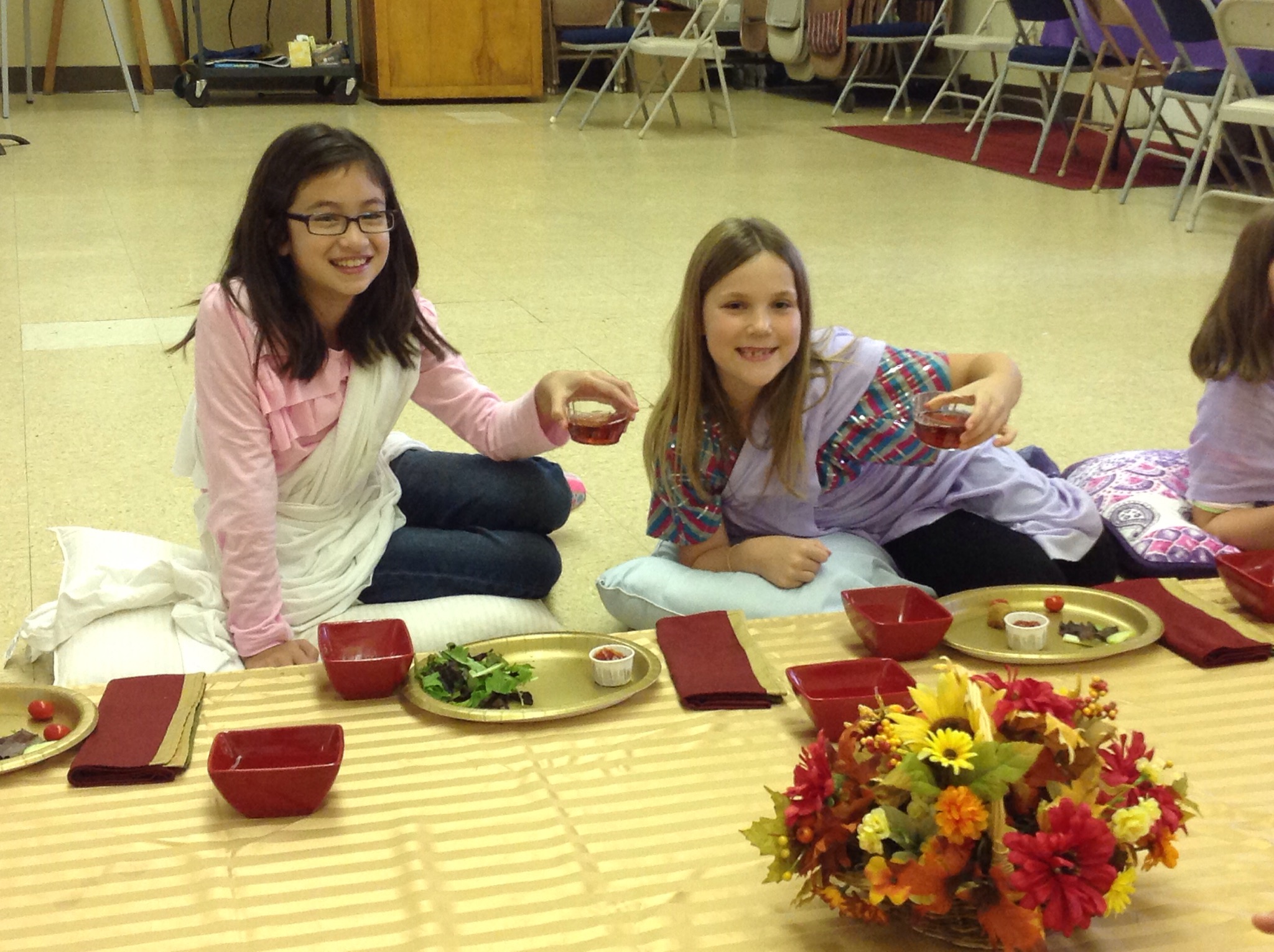
dining. The students helped construct a model of a Roman dining room, complete with Gumbius figures. Finally, the class participated in a banquet featuring foods from ancient Italy.
We started off our school year focusing on grace and courtesy to teach and fulfill our student’s innate need for order. Every student has a need to know and to absorb the social structures in order to be
more at ease in their environment. Grace and courtesy lessons give the student the vocabulary, actions, and steps required for them to build their awareness and responsiveness of those around them. We worked on walking in the classroom, using our inside voices while in the school building, using kind words to one another, using safe hands, how to clean up our area when we are done working and how to use our words to express our feelings.
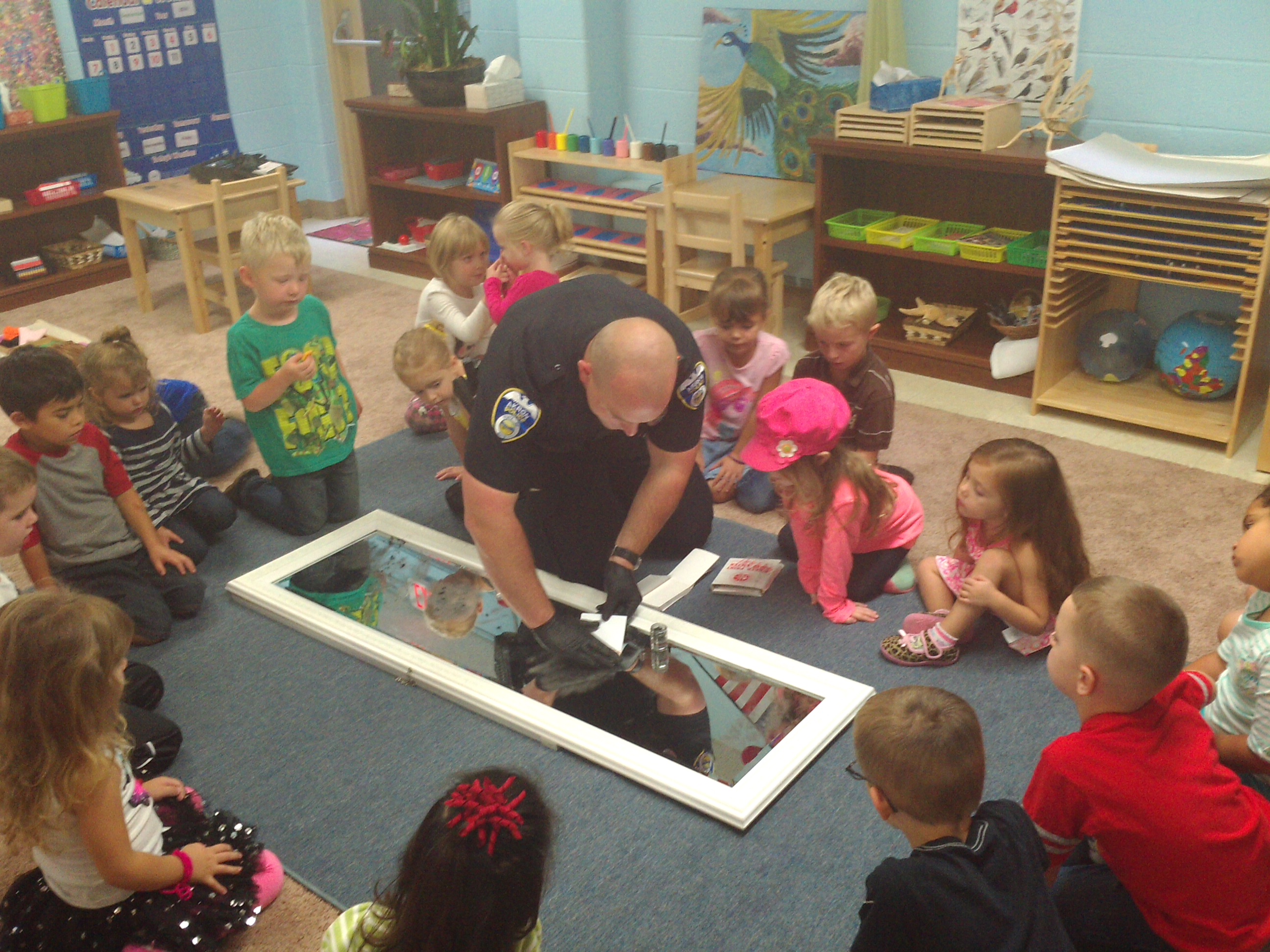
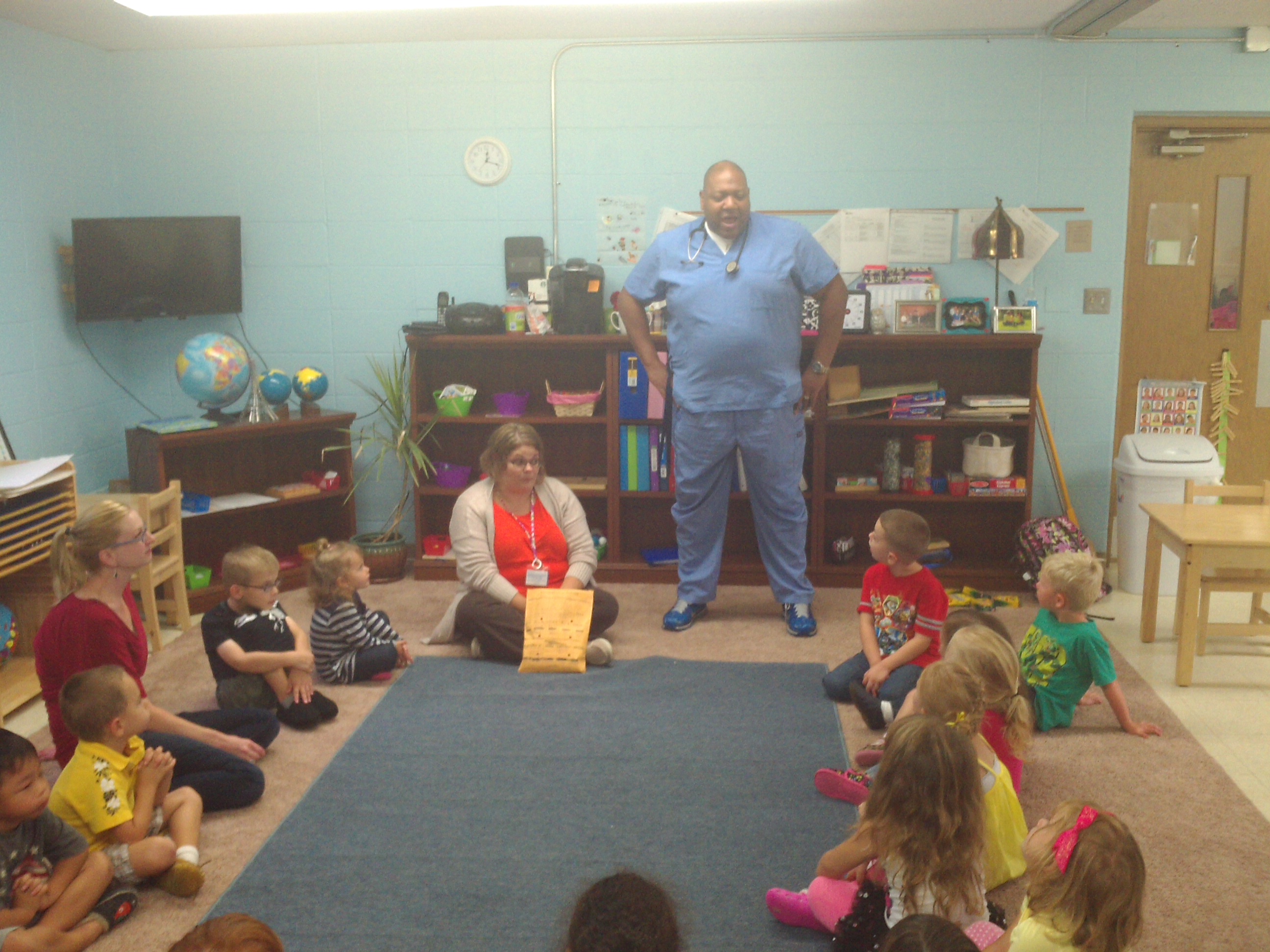
The third week of school we talked and learned about community helpers. We had many of volunteer community helpers come into the classroom and talk to the children. They briefly described their occupation, by talking about where they work, what they wear, tools they use, and tasks they perform. I would like to thank all of the volunteers who came into the classroom! It was a wonderful learning experience for both the students and myself! The fourth week of school we discussed families and the students shared their family trees with their friends. Their family trees included their name, parents, grandparents, and great-grandparents. The students also brought pictures of their families either on the family tree or hard copies for the children to share with their friends. The children enjoyed learning more about their friends and where they came from. It was great to see the students discover the differences and similarities in all of the families and accept every family for who they are. We ended the month of September talking about feelings and emotions. The students brainstormed things they could do when they were angry, happy, sad, frustrated, and excited. Then they discussed with one another whether the reaction they came up with was a good choice or a bad choice. The students did a great job learning how to manage their emotions. We role played how to process, identify and appropriately express their emotions as much as possible. After a few days of talking about feeling and emotions it was great to hear the students tell their friends what they were feeling and why on their own.
Kindergarten
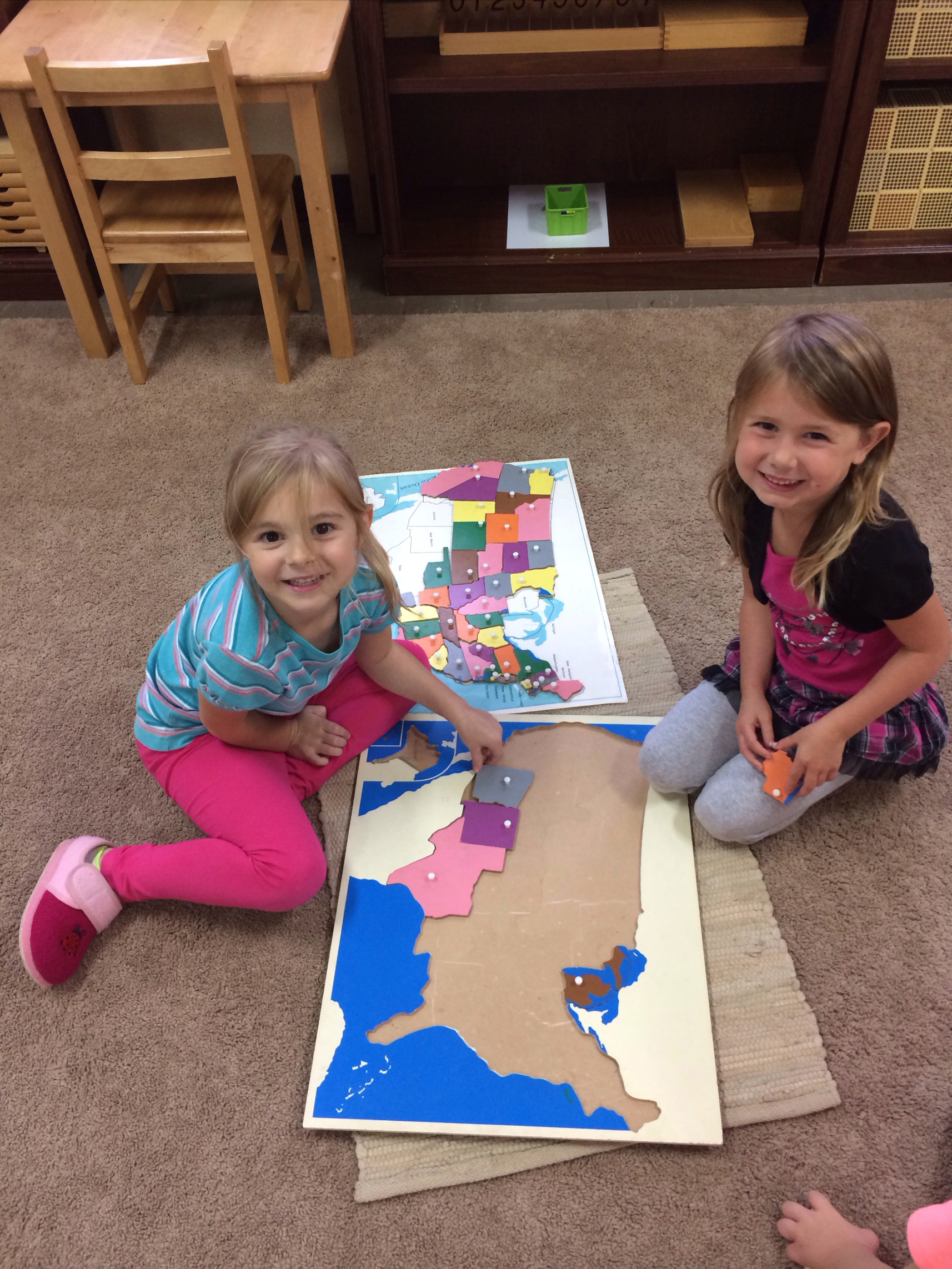
We kicked off Kindergarten with a lot Geography. The students learned about the seven continents, fun facts about the continents, and a few countries in each continent. The students became very familiar with the cardinal directions, the equator, the prime meridian, and the hemispheres. We took a look at our home state of Ohio and the surrounding states (their abbreviation and nickname). Make sure you ask your child all about Ohio! They will be able to tell you that the cardinal is the official bird, scarlet carnation the official flower, lady bug is the official insect, and tomato juice is the official drink. They learned how we are the buckeye state and that the official rock and roll song is Hang on Sloopy.
Art
The first month of school flew by, and the students have already learned so much in art class with Ms. Michele. Her first unit of study is “What is Art?” We learned what an artist is and what they do. The children will get to explore the color wheel and art terms. They will be learning key art rules and how to use the art materials.
Ms. Michele kicked off her unit with a project called “My Favorite Animal” inspired by Eric Carle. She read “The Very Hungry Caterpillar” and then discussed the techniques Mr. Carle uses in his illustrations. He uses overlapping colors of tissue paper to create the wonderful pictures in his books. The students then made textured rubbings on tissue paper and glued them together on a piece of paper to create their favorite animal.
The next concept the students learned was about primary colors. They learned that these colors are blue, red, and yellow. These colors can be mixed together to create other colors. The project for the second week was “My House.” Ms. Michele was inspired by Piet Mondrian’s “Composition in Red, Blue, and Yellow” due to his use of the three primary colors. The students mapped out their house using black Popsicle sticks to create the same shapes that Mondrian used in his art piece, and red, yellow, and blue paint.
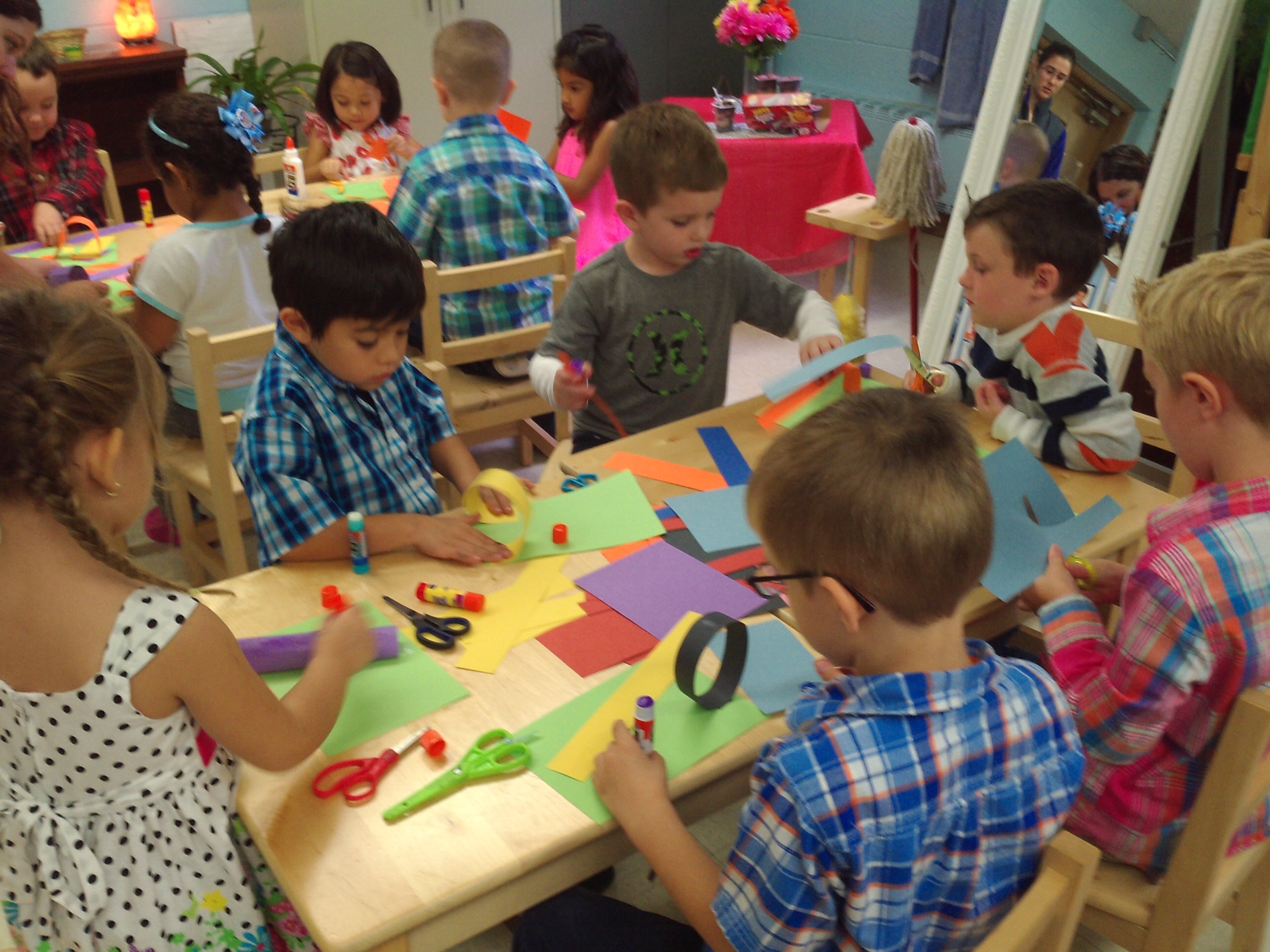
Our last lesson of the month was entitled “The Best Playground Ever.” Ms. Michele showed the students pictures of different playgrounds. One was a typical playground we see in our neighborhoods, one was made completely out of nets, and the last one was shaped like a whale. The students discussed the different shapes and lines of the equipment and discovered that art isn’t just flat. They were then allowed to create their own playground by twisting, bending, crimping, and rolling pieces of paper and then gluing them to a base.
We all want to thank Ms. Michele for bringing in her wonderful, creative ideas and are excited to learn more next month!
Science
For our first science experiment of the year the students learned how liquids like water and milk have a property known as surface tension. We used soap, milk, and food coloring to experiment with reducing the surface tension to see what would happen. The students first put food coloring in the milk and noticed that the drops of food coloring just sat on the surface where we placed them in the milk. We discovered that is because food coloring is less dense than milk, so it floats on the surface, and the colors do not mix because we didn’t stir the milk. Then the students wanted to see some action so we added a drop of soap. The soap reduced the surface tension of the milk by dissolving the fat molecules and the food coloring started to move with the surface!
Music
“It’s music time today. Time to sing and play. It’s lots of fun to sing and learn. It’s music time today.” The students have learned that this song is true for music class with Ms. Lisa. At the start of every music class, Ms. Lisa sings this with the students to get them excited and ready to learn. Our returning students were so thrilled to start music class and our new students have found out what a joy it is to spend time with Ms. Lisa.
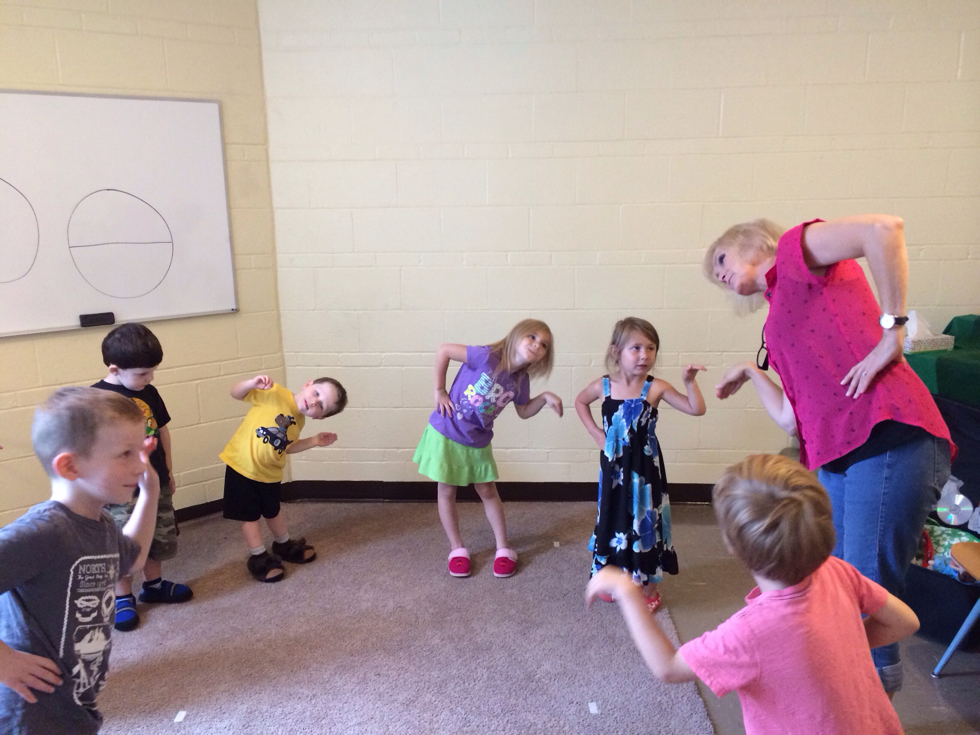
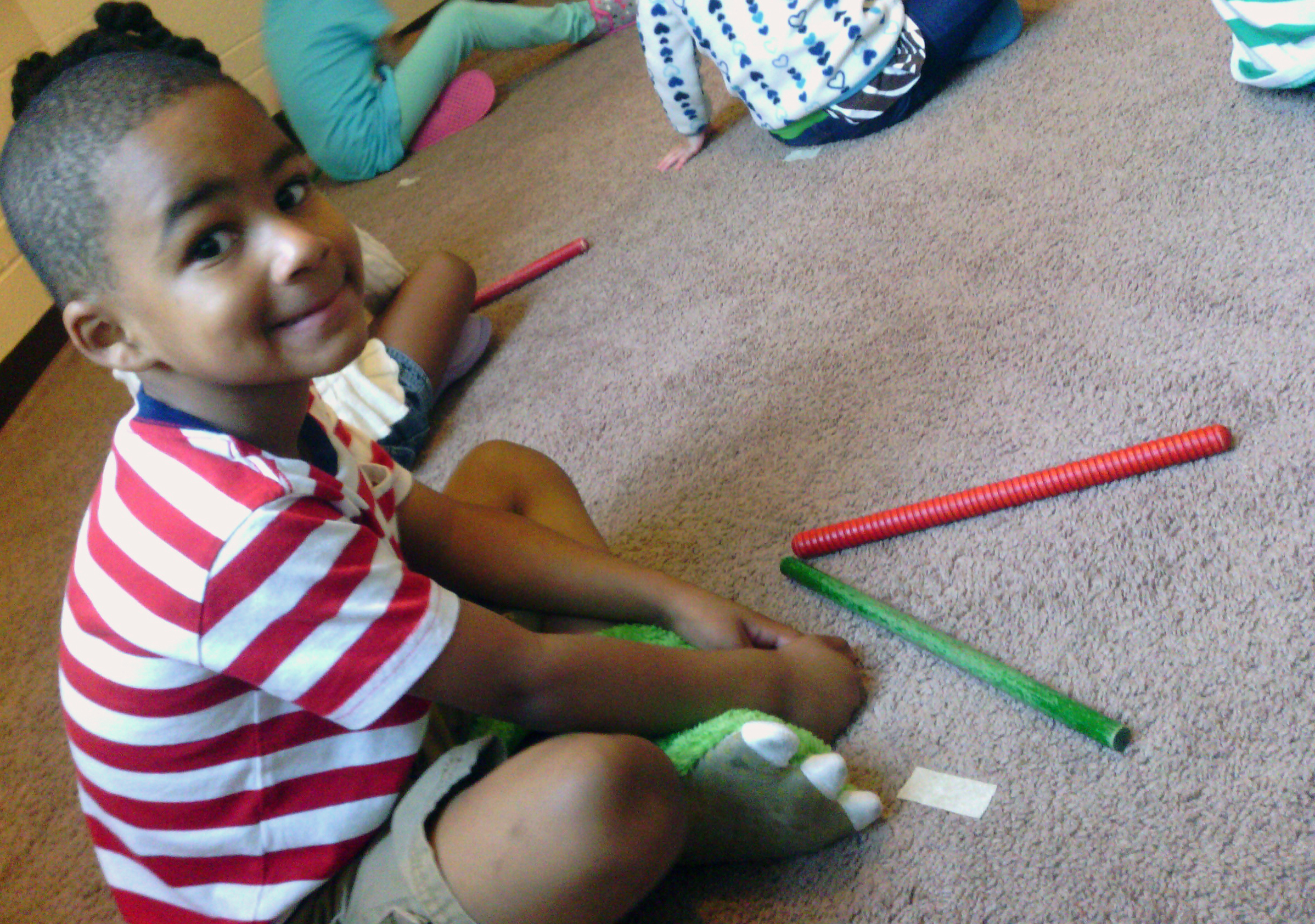
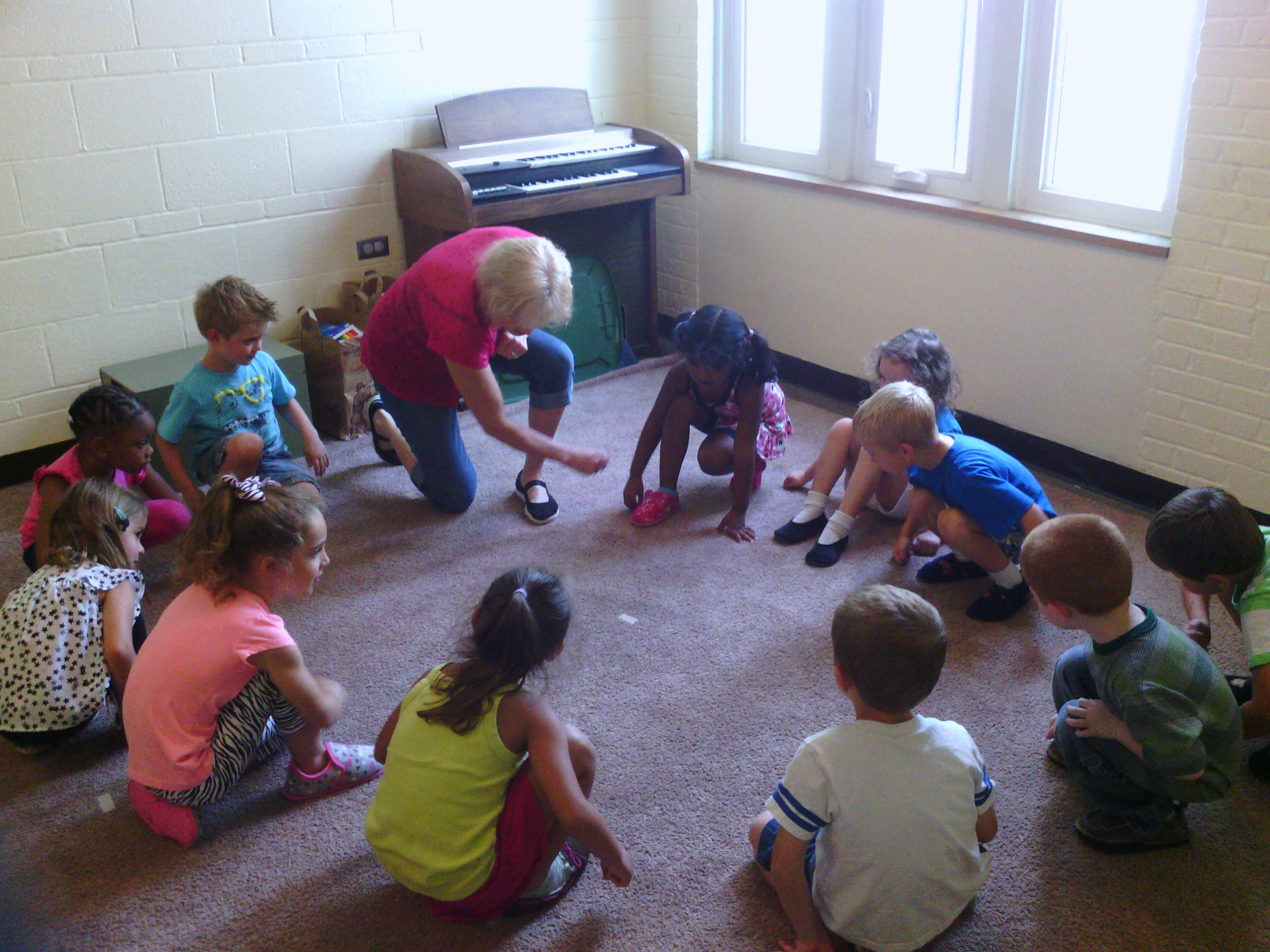
During this past month, the children met our wonderful music teacher, Ms. Lisa and were introduced to many musical concepts. They have experienced how to use rhythm sticks, egg shakers, and tambourines. The class learned what a whole, half, quarter, and eighth note look like and how many beats each one receives. Ms. Lisa also shared with us some fun classics, such as “London Bridge,” “The ABC’s,” “The Hokey Pokey,” and “I’m a Little Tea Pot.” The students always enjoy having Ms. Lisa come each week and we can’t wait to learn more next month!
Our Academic Enrichment time is daily from 12:00-1:00pm. This time is specifically designed for our Kindergarten students to join together as a group to work and progress through the advanced materials and lessons in the Montessori primary curriculum. Throughout the school day in their classroom they are still working individually with their classroom teacher on these and other materials at their level.
9/29: Biggest (Solar System) to Smallest (your home)
Review hemispheres
Introduction to solar system and planets
Our continent, our country, state and county
City, street, address and phone numbers
10/6:Landforms
Island/Lake, Isthmus/Straight
Bay/Cape, Peninsula/Gulf
Archipelago/Chain of Lakes
Use of landform cards, and water trays
10/13: Telling Time
Parts of the clock
Telling time to the hour
Telling time to the half hour
Flashcards, Clock & Worksheets
10/20: Telling Time
Telling time to the quarter hour (quarter past/ quarter till)
Flashcards, Clock & Worksheets
10/27: Telling Time
Review telling time to the hour, half and quarter hours
Telling time to the minute
Flashcards, Clock & Worksheets
Letters of the week 9/29: Dd 10/6: Ee 10/13: Ff 10/20: Gg 10/27: Hh
Things to do at home this month to reinforce our themes:
Practice telling time on the clock at home. When you sit down to dinner, ask them to tell you what time it is, when they go to bed, have them check the clock. Have fun with Time!
Our Academic Enrichment time is daily from 12:00-1:00pm. This time is specifically designed for our Kindergarten students to join together as a group to work and progress through the advanced materials and lessons in the Montessori primary curriculum. Throughout the school day in their classroom they are still working individually with their classroom teacher on these and other materials at their level.
09/29: Biggest (Solar System) to Smallest (your home)
Review hemispheres
Introduction to solar system and planets
Our continent, our country, state and county
City, street, address and phone numbers
10/06: Landforms
Island/Lake, Isthmus/Straight
Bay/Cape, Peninsula/Gulf
Archipelago/Chain of Lakes
Use of landform cards, and water trays
10/13: Telling Time
Parts of the clock
Telling time to the hour
Telling time to the half hour
Flashcards, Clock & Worksheets
10/20: Telling Time
Telling time to the quarter hour (quarter past/ quarter till)
Flashcards, Clock & Worksheets
10/27: Telling Time
Review telling time to the hour, half and quarter hours
Telling time to the minute
Flashcards, Clock & Worksheets
Sight Words of the Week: 09/29: from he 10/06: you his 10/13: for with 10/20: she were 10/27: use your
Synonyms of the Week: Try to find each word in books as you read to your child. 09/29: ACTIVE, lively, energetic, dynamic, vigorous, hasty 10/06: CALM, peaceful, quiet, inactive, serene, slow 10/13: HOT, burning, scorching, blazing, boiling, sizzling 10/20: COLD, freezing, chilly, frigid, frozen, cool 10/27: NEW, novel, fresh, original, unique, current, unused
Things to do at Home this Month:
Practice telling time on the clock at home. When you sit down to dinner, ask them to tell you what time it is, when they go to bed, have them check the clock. Have fun with Time!
Mr. John will be sending homework home to reinforce these lessons. Please turn homework into the orange box outside of Mr. John’s classroom. Please email him if you have any questions: jkotradi@thesmarterkids.com.