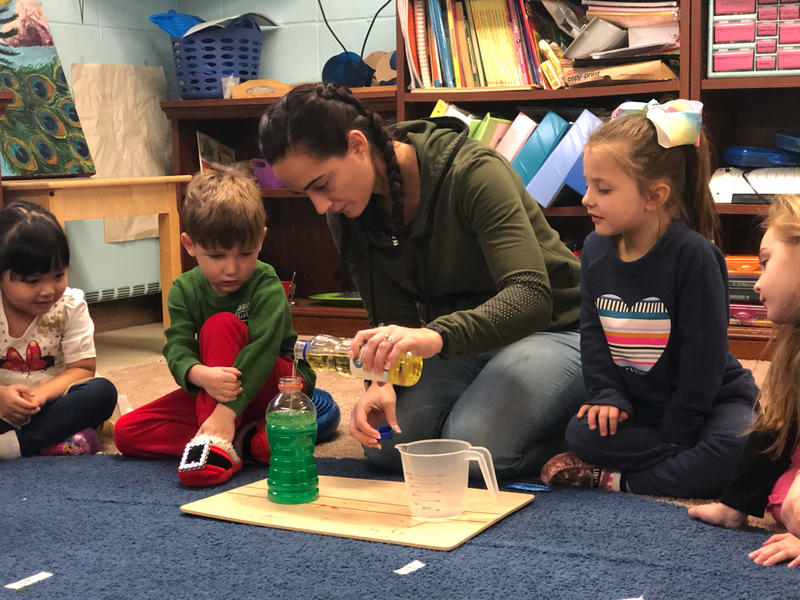
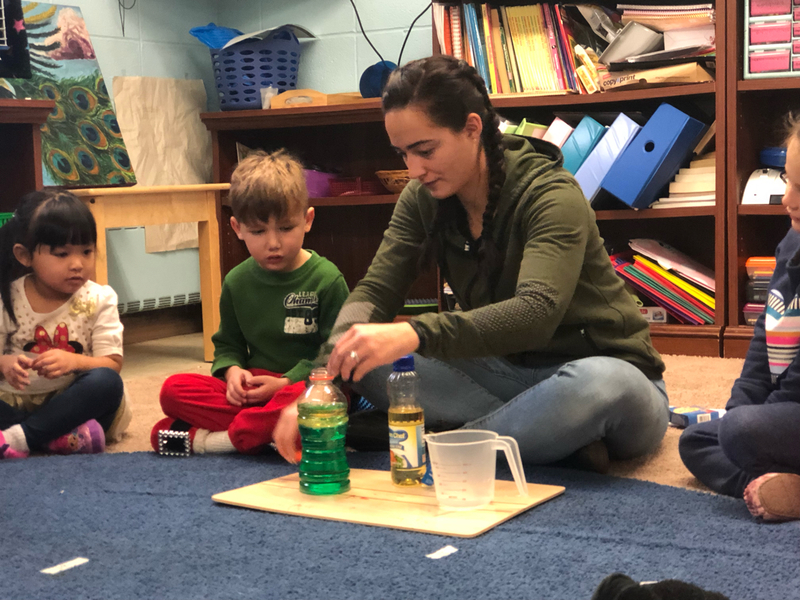
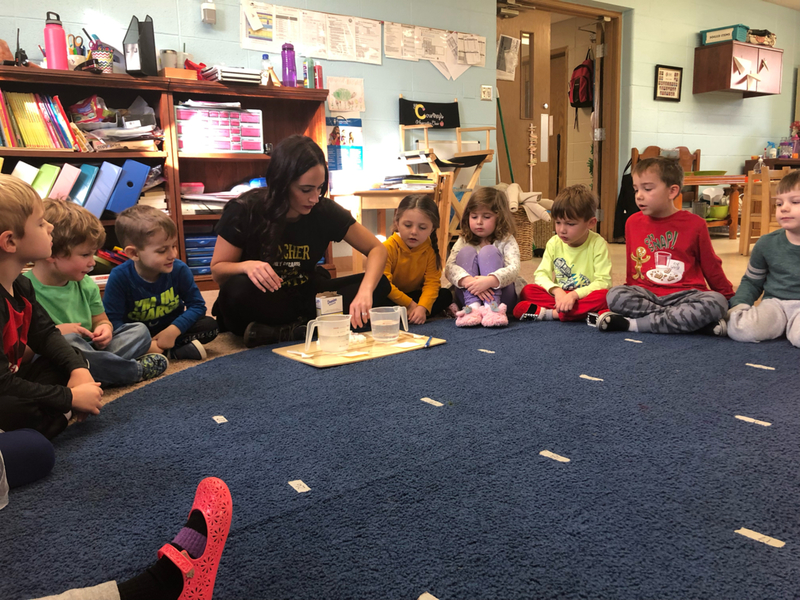
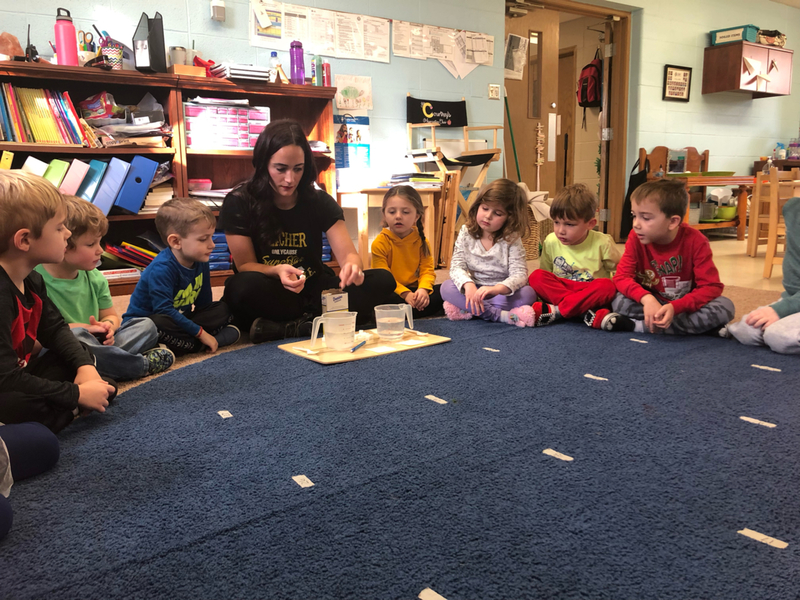
Lava Lamp: The students observed that when you mix oil and water together they separate from each other. The oil ended up on top because it has a lower density than the water. We then added food coloring and watched it fall through the oil and mix with the water at the bottom. We then added tiny pieces of Alka-Seltzer which created small bubbles of carbon dioxide gas that would rise to the top. The gas would then escape when it reached the top and the colored water would fall back down. The students learned the reason the Alka-Seltzer fizzed in such a way is because it contains citric acid and baking soda and the two react with water to form sodium citrate and carbon dioxide gas.
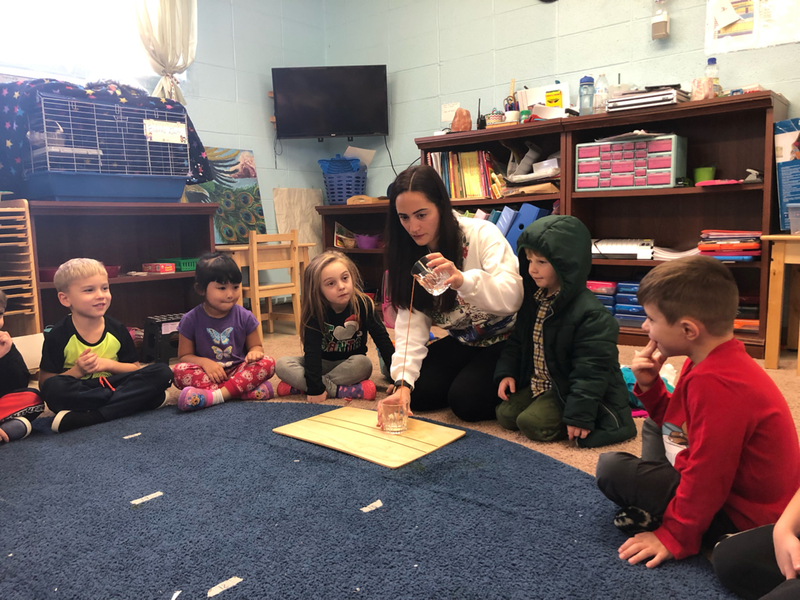
Traveling Water: The students learned that water has a lot of molecules that are held together by electrical molecular bonds. So we took a glass of water with a piece of string and and dumped the water along the string and into the empty glass. Because water has such strong hydrogen bonds it allowed the water molecules to stick together and travel down the string and into the empty cup.
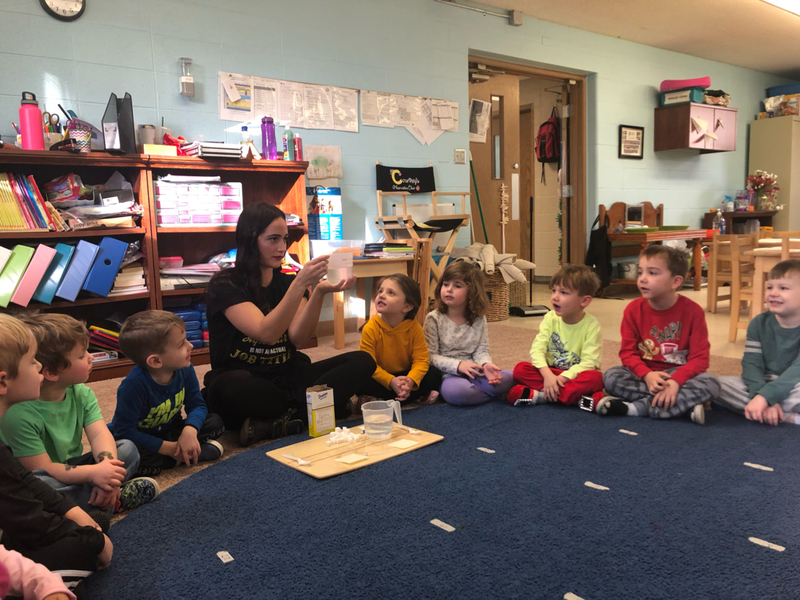
Dissolving Sugar: We dissolved sugar in both cold and hot water. The students were able to observe that the cold water wasn’t able to dissolve as much sugar as the hot water. The reason the hot water dissolved more sugar is because it has faster moving molecules which are spread further apart than the molecules in the cold water. So with bigger gaps between the molecules in the hot water, more sugar molecules can fit in between.
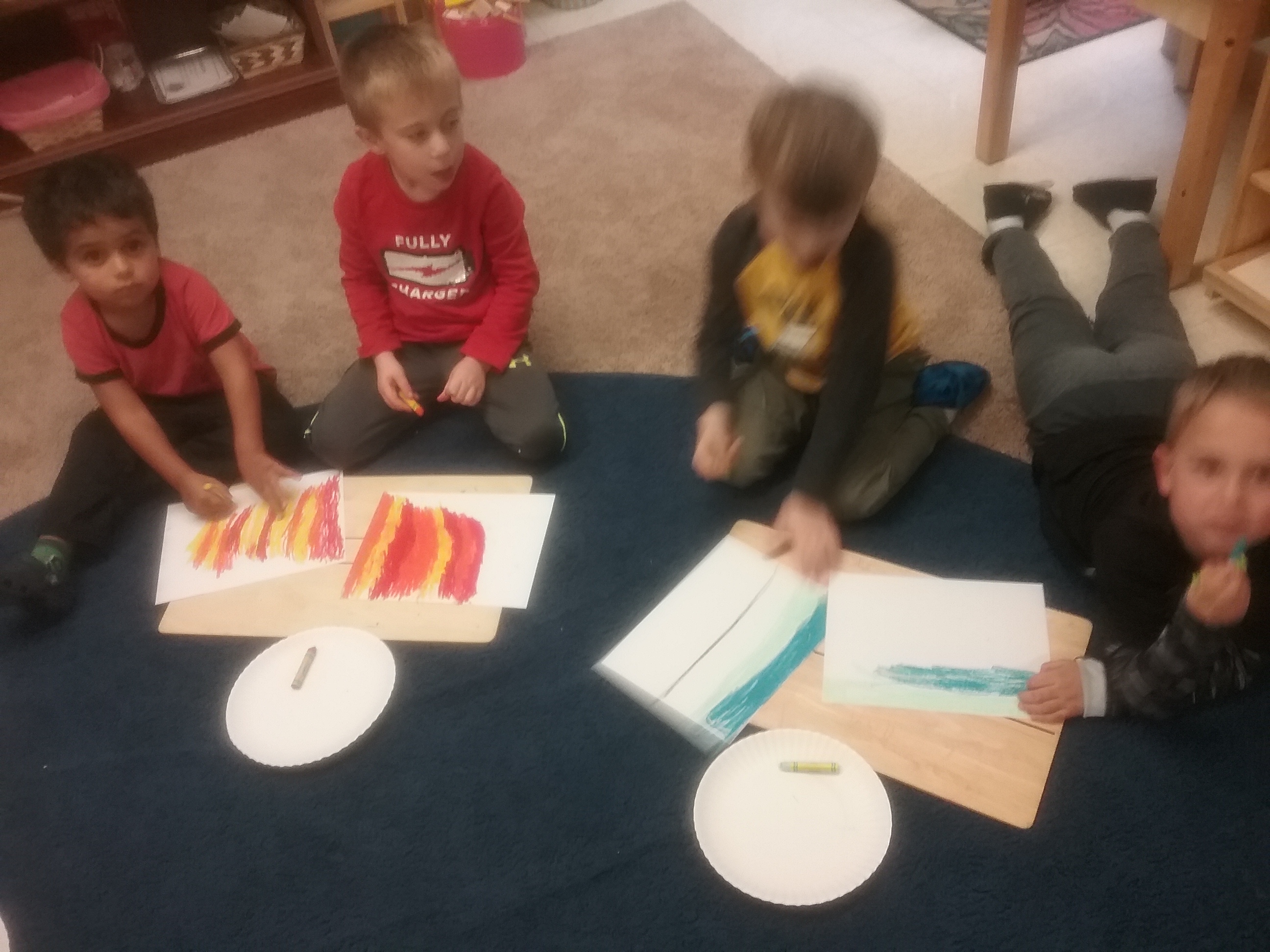
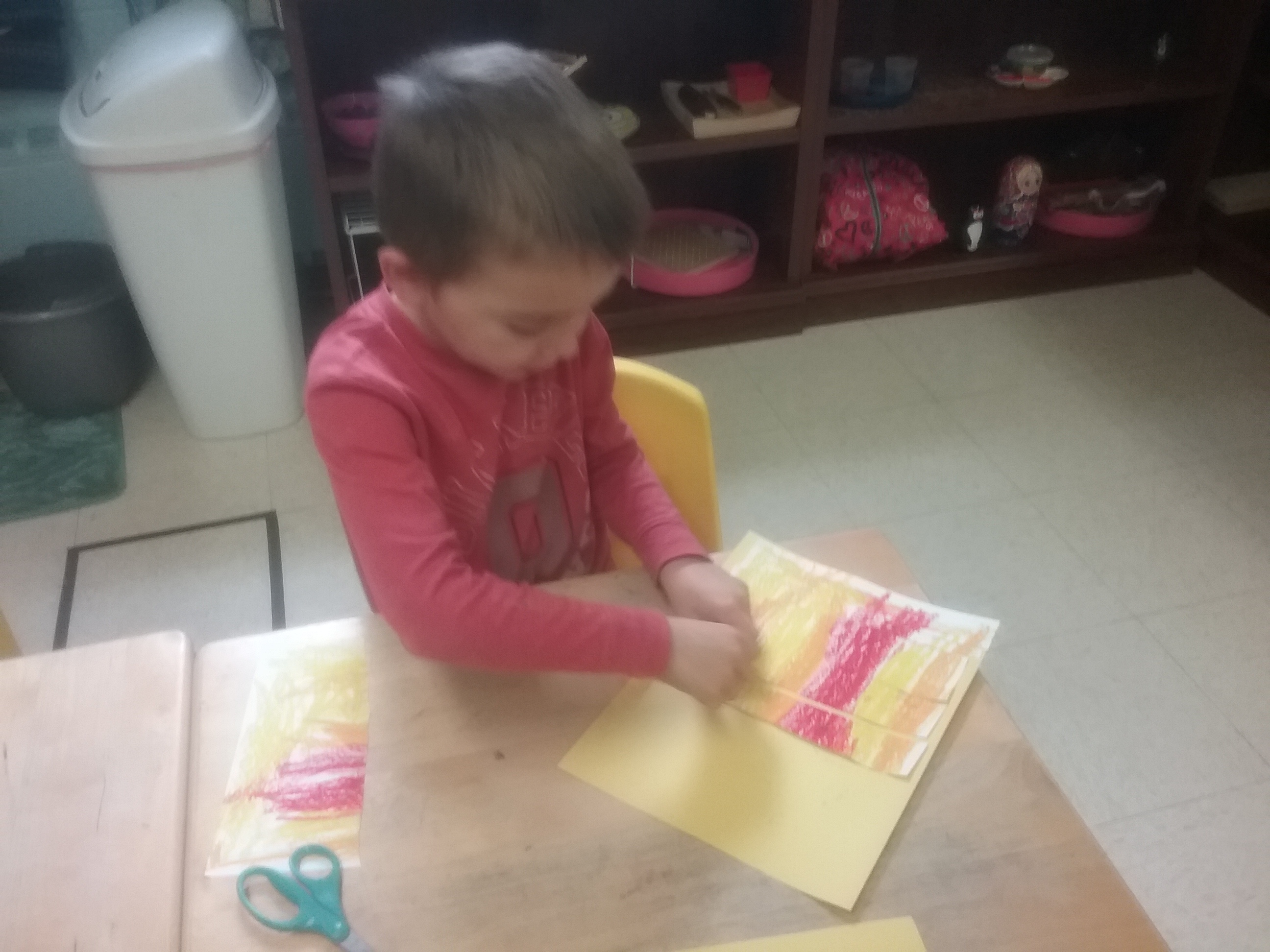
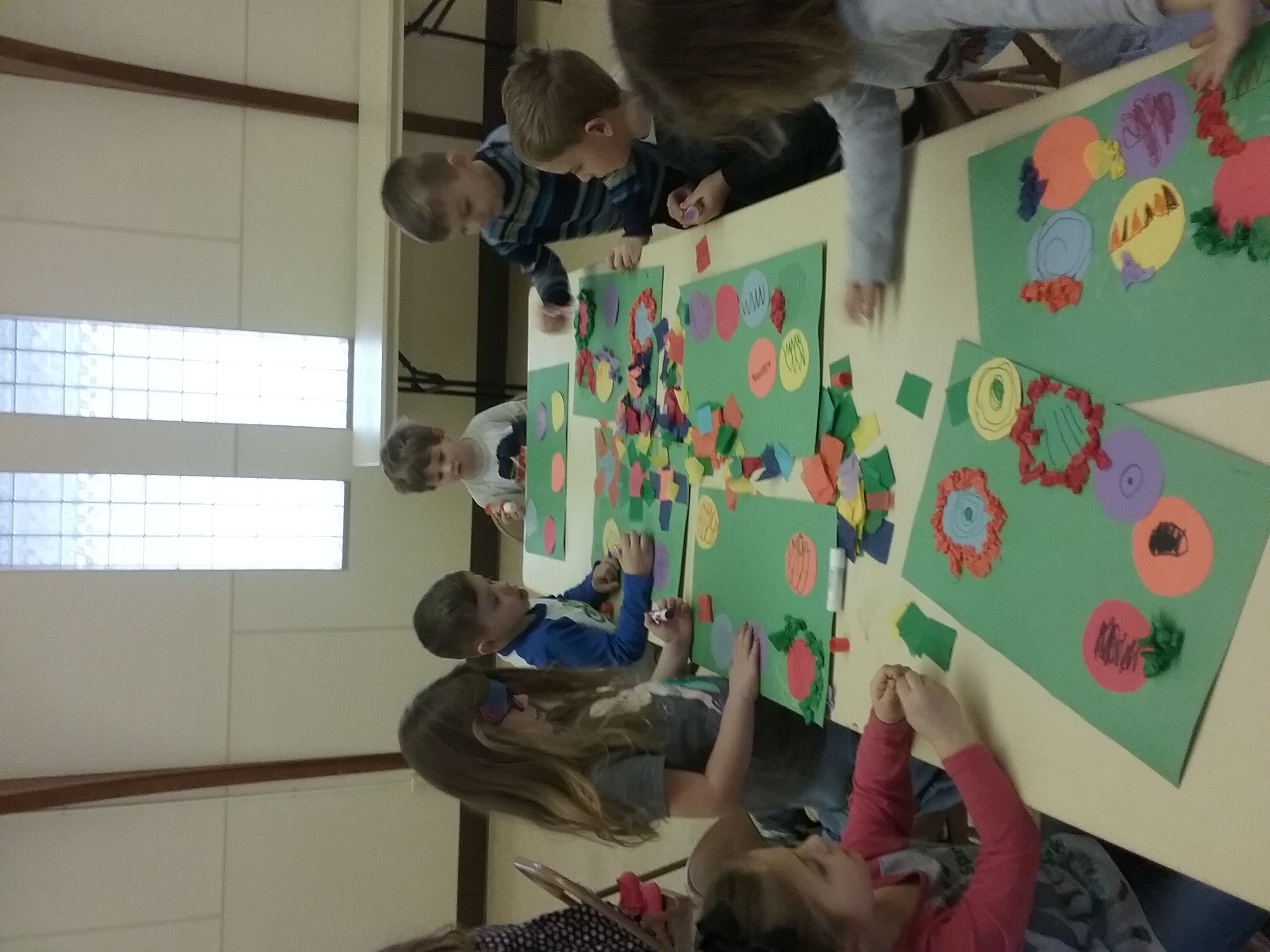
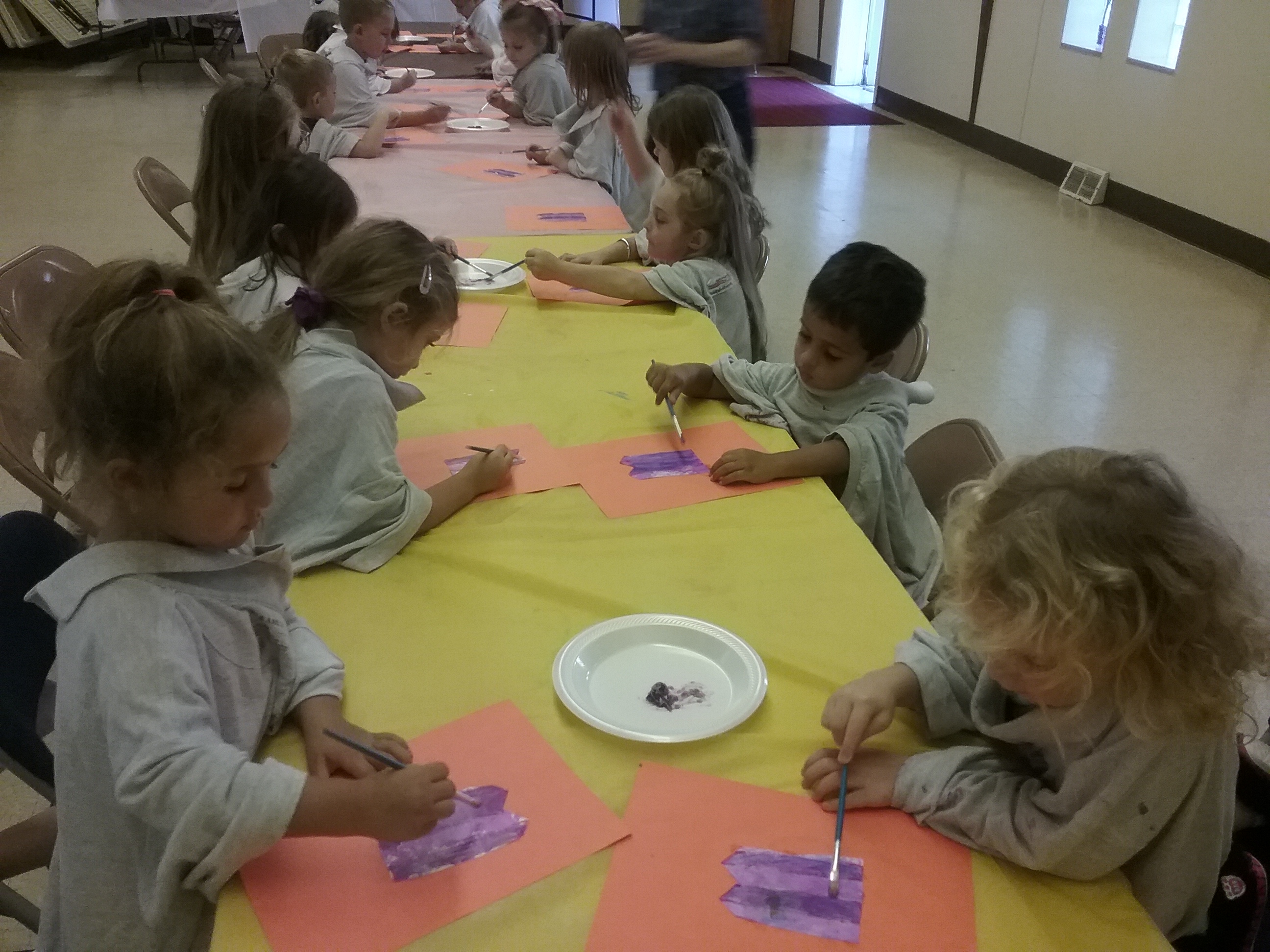
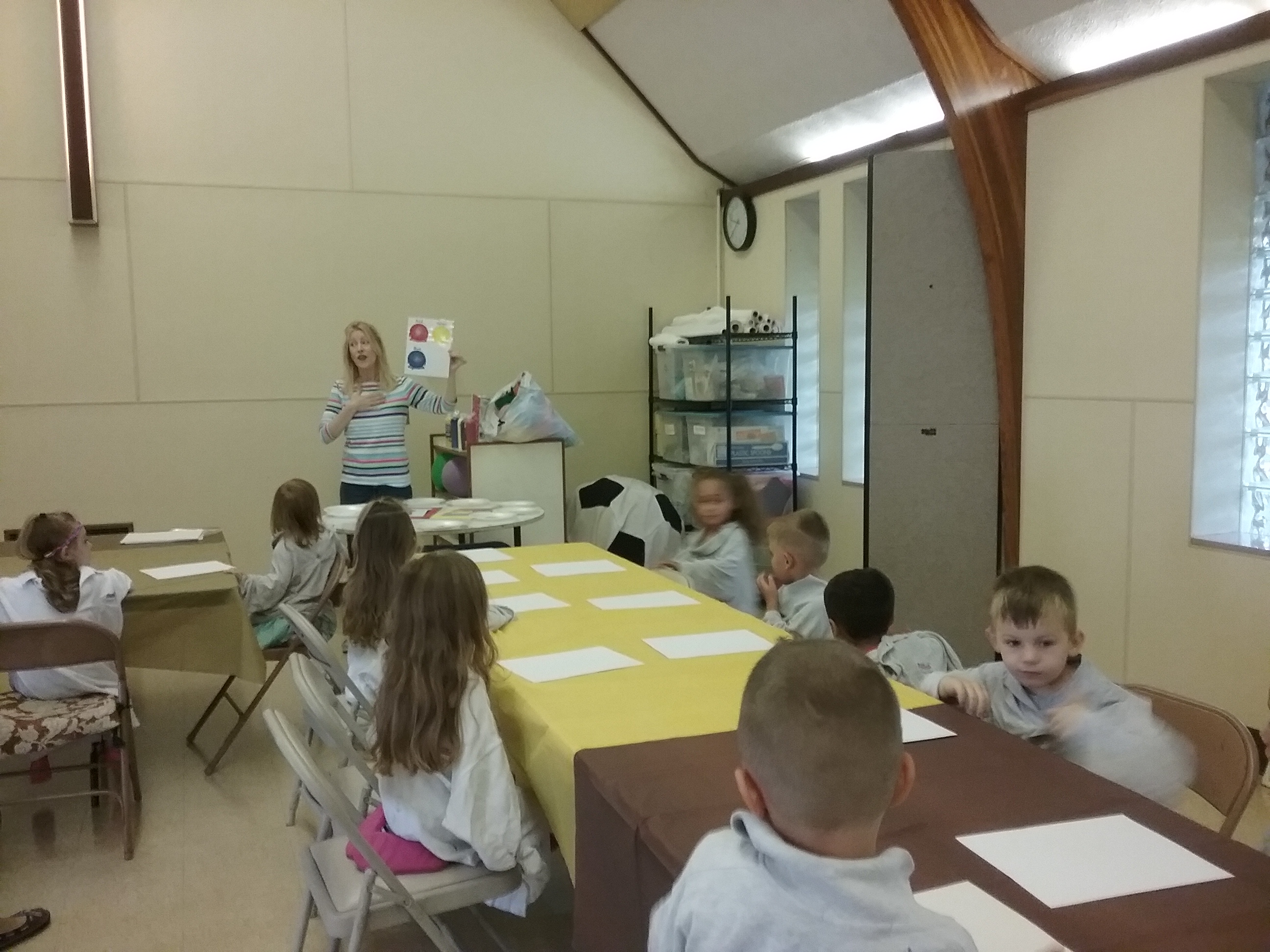
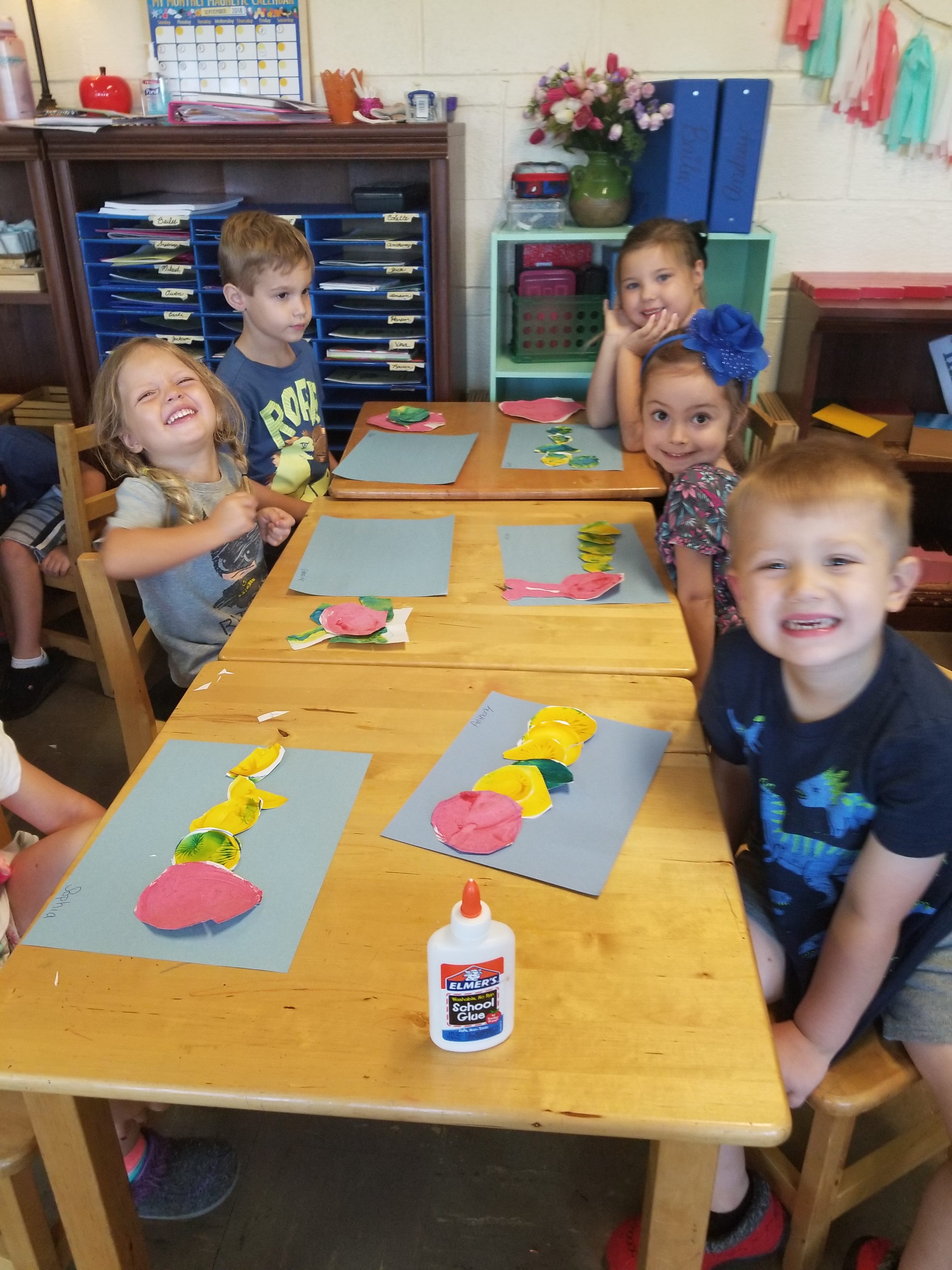
This month I focused on colors while contiuing to practice with art materials. The primary students learned about warm and cool colors. They found out that warm colors make you think of warm things like fire and the sun, and cool colors make you think of cold things like water and the earth. The students used oil pastels to color their papers then cut them up in strips and glued them to construction paper.
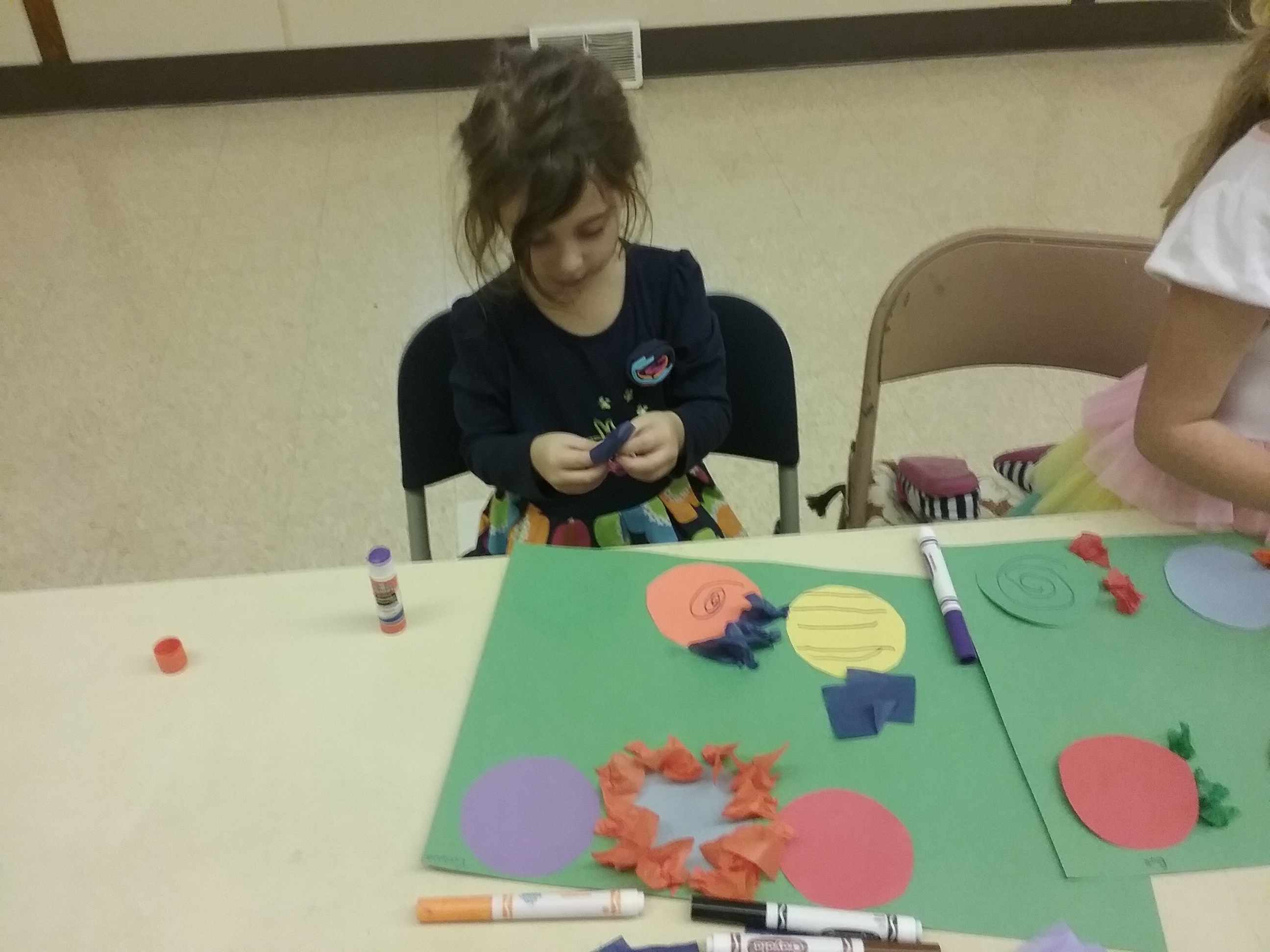
Next, the Primary students learned about complimentary colors. They found out that complimentary colors are opposite of each other on the color wheel, and when they’re combined in the right way create white light. For our project, the students glued down the center of a flower and then glued the complimentary color of tissue paper around for the petals. Then to add a finishing touch, the group decorated the center of the flower with different lines, which they learned is a segment that has a start and an end.
Welcome to another month of science! Mr.John has kept us busy with new science experiments.
During each science activity, we always come up with our own hypothesis. A hypothesis is an educated guess. A great part about Mr.John’s science class is that it never matters if our hypothesis is wrong or right! Mr. John always tells us that it is okay to be wrong because sometimes even scientists are wrong! That is how they learn what works and what doesn’t work.
Don’t forget to check your students science paper in their folder ever Thursday to see what their hypothesis was for that weeks experiment!
Distribution of Weight
Materials needed to complete this activity at home:
Books
A piece of paper
A couple of rubber bands
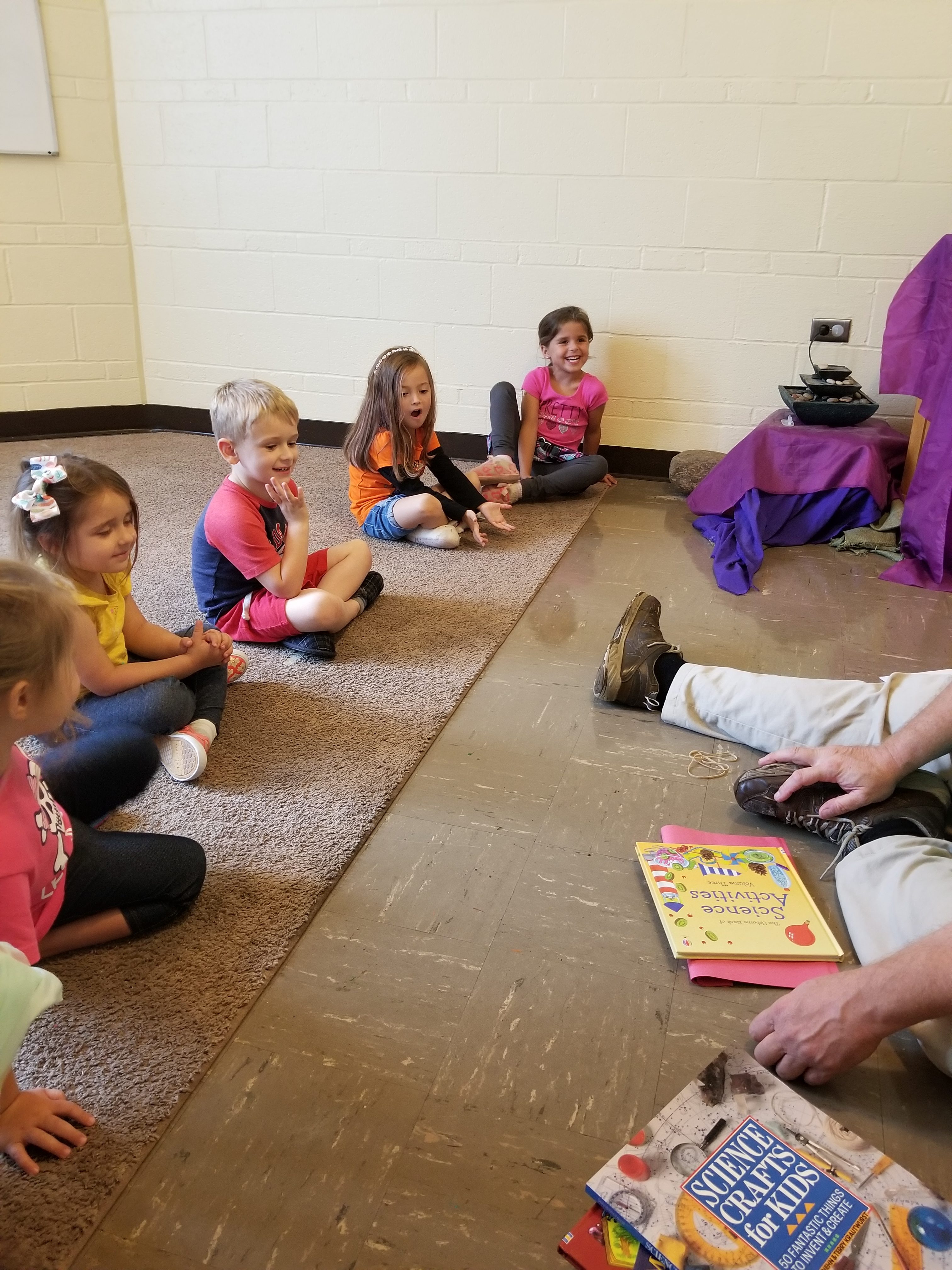
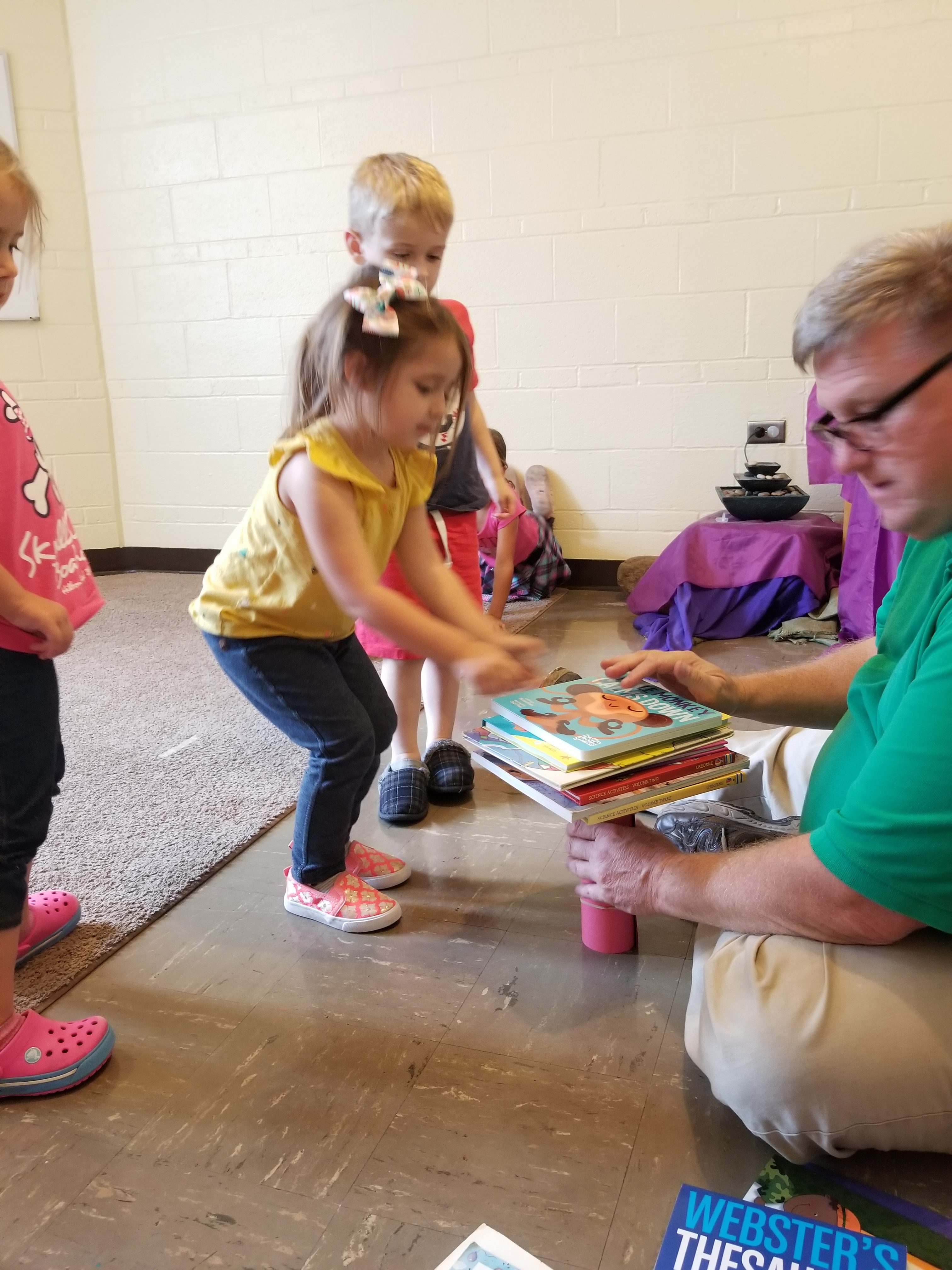
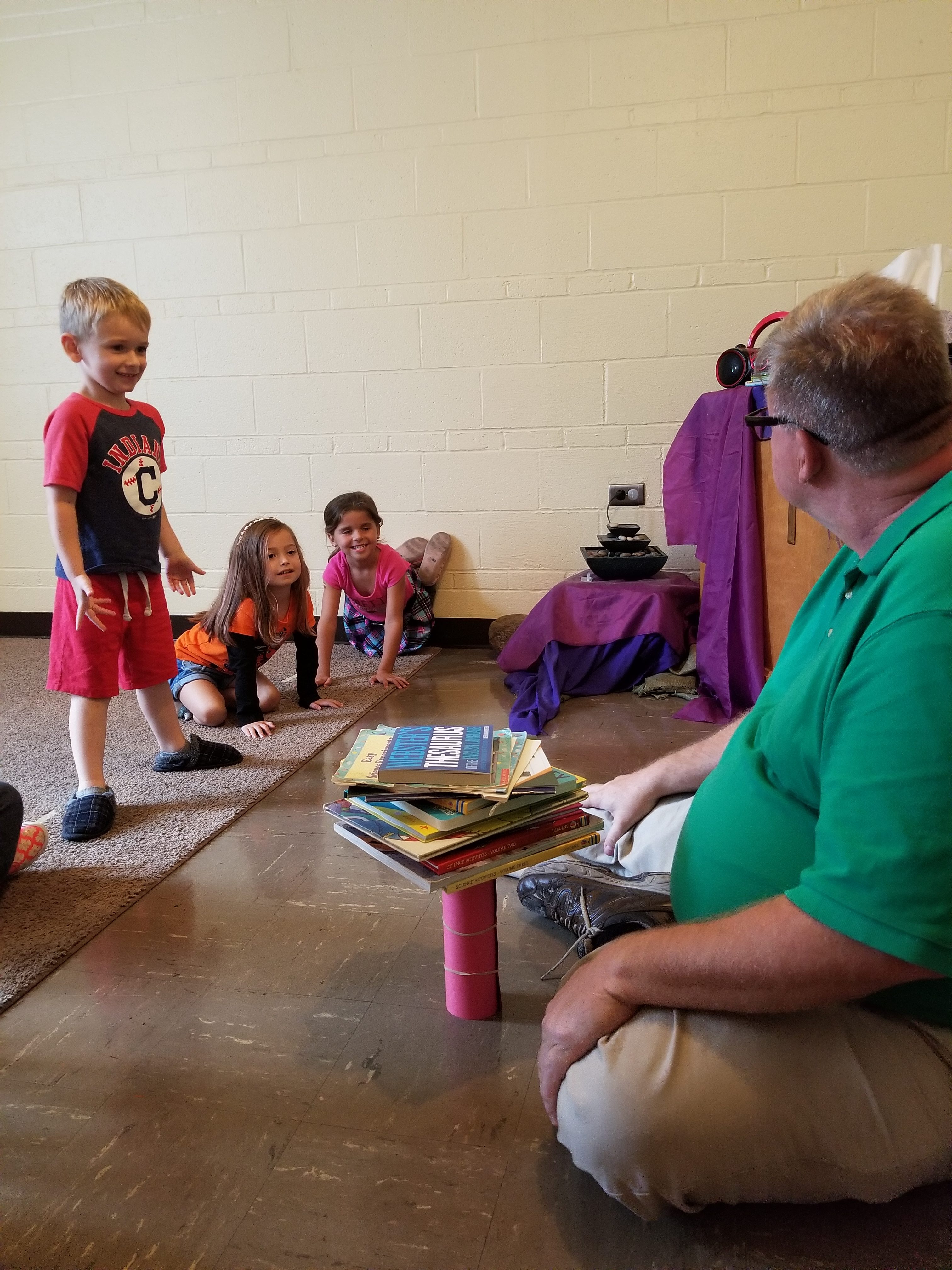
Question of the week: What will happen when we try to balance a text book or multiple picture books on a piece of paper? What about when the piece of paper is turned into a cylinder?
Well, the flat paper got squished by the books! Then Mr. John turned it into a cylinder using rubber bands. What happened next?
The cylinder of paper supported all the picture books! Amazing!
But why was the cylinder of paper able to hold the book, but the single piece of paper did not? SCIENCE!
The average weight of a piece of paper is .7 grams. It makes sense that it wouldn’t be able to balance a book! It just collapses under the weight of a book. This is because the paper is unable to keep it’s shape. It wants to return to a flat position. But, when Mr.John uses rubber bands to keep the paper in a cylinder shape, it all changes.
The secret to the paper’s new found strength is the geometrical shape known as a cylinder! Cylinders are one of the most structurally sound and strongest geometrical shapes. They are able to be strong because they disperse stress throughout their entire shape. If the rolled-up piece of paper were a perfect cylinder, the strength of it would be even stronger!
Teflon Tape Secret Message
Question: What will happen if we write a secret message on a strip of Teflon tape?
Materials Needed:
Teflon tape
Permanent marker
This week Mr. John introduced us to polymers! On the Teflon tape Mr. John wrote GO BUCKEYES! Then he stretched the tape out so much, we couldn’t read his message anymore!
Then he pulled on it again and SCIENCE made the letters legible again! But how?
Teflon tape is a type of polymer called polytetrafluoroethylene (PTFE). That’s a really long word for a kind of polymer that has long chains of molecules lined up side-by-side and on top of each other. Polymers like to be near each other. After Mr. John stretched the tape, the polymers that make up the tape were all puled apart. When Mr. John pulls in the opposite way on the tape firmly, the polymers become reconnected together which allows the message to be legible again.
Friction
Mr.John was absent this week, so I (Miss Ame) stepped in with a shortened version of science for our classes.
Materials:
Spider print out
Sewing thread
cardboard
Match
The spider was glue to a small piece of cardboard. On the other side of the cardboard was a match attached to it with glue. In between the match and the cardboard was a piece of thread.
Using our imagination we pretended that the thread was the spider’s web. While I was holding both ends of the web tightly, the spider did not move. He was suspending sitting still in his web.
I then asked the student’s what they thought would happen if I let go of the string that I was holding our spider. Would he fall? Would he stay hanging on his web? So each child shared their hypothesis, all starting their sentence with “My hypothesis…”
On the count of three I let go of the spider…..and he fell quickly to the end of his web! But why?
Because of friction!
When the thread is held taut, it touches the match. This causes friction between the match and the thread, which is strong enough to stop the spider from moving down the thread. But, when you let it go slack it no longer touches the match. This means less friction, so the spider slides easily down.
How much fun we have had in science this month! Thank you Mr. John!
Floating Eggs: The students discovered that as an egg ages, air enters the egg and the air cell becomes larger. They learned to test an egg for freshness they can place it in a bowl of water. The fresh eggs will lie on the bottom of the bowl. Eggs that tilt so that the large end is up are older, and eggs that float are rotten.
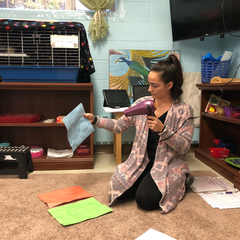
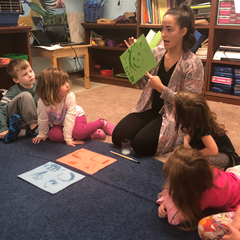
Invisible Ink: We dipped a paint brush into lemon juice then drew pictures onto different colored paper. After the paper totally dried we used a hair dryer to heat the paper up revealing the original pictures we drew. The students discovered that lemon juice is an organic substance that oxidizes and turns brown when heated which is why we were able to reveal the hidden pictures.
We have been studying Pop Art and the artist Andy Warhol. They learned how to shade objects on one side to create a three-dimensional look. We made a series of the same object in four colors on bright colored backgrounds like the artwork of Andy Warhol. Look for their Pop Art to be hung in the hallways soon!
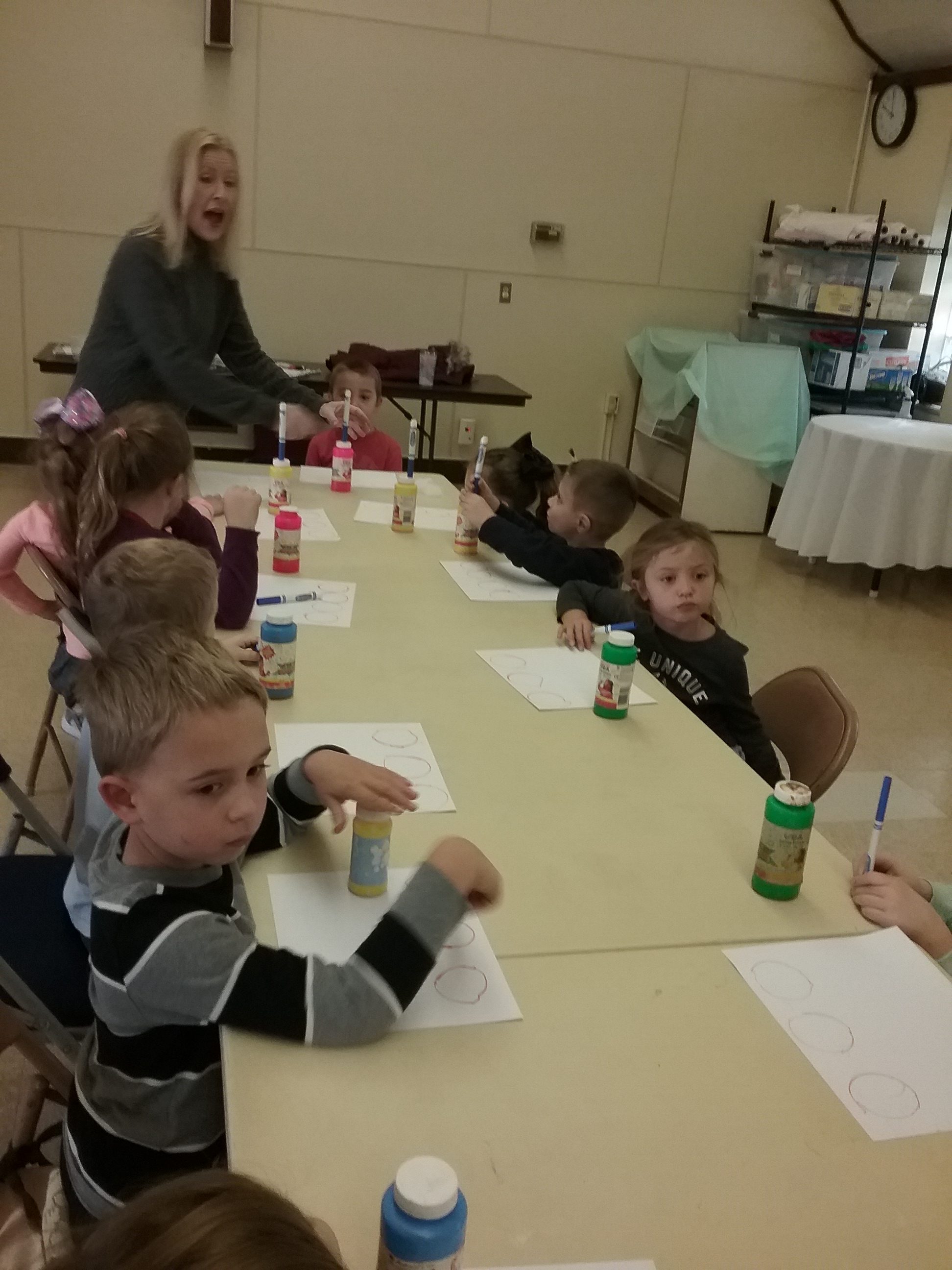
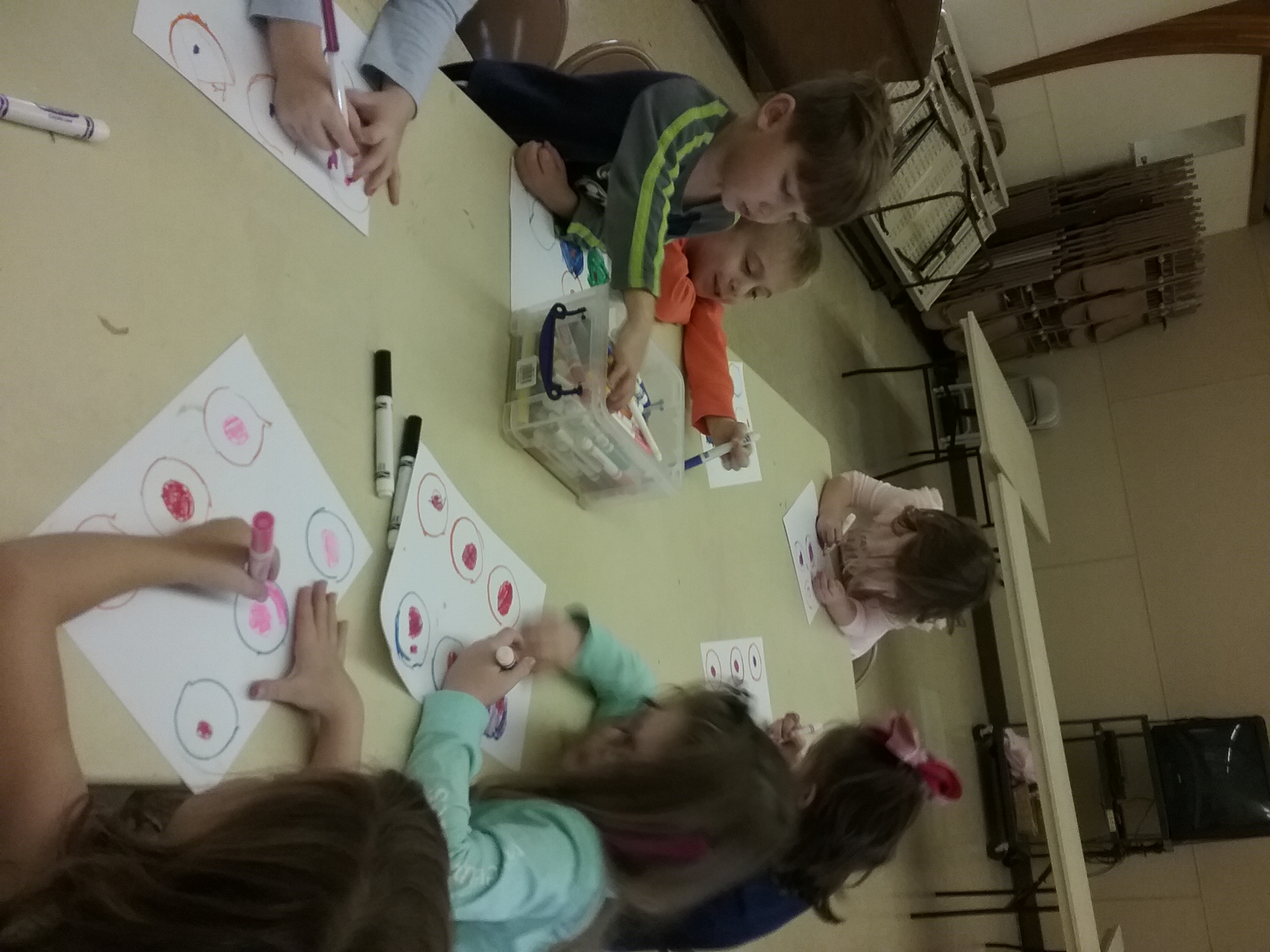
We also studied the artist Wassily Kandinsky and his painting of eccentric circles. I had the students draw several circles in two rows. I then had them draw circles inside the main circles. We then used markers to color each of the circles and inner circles different colors as like Kandinsky did in his painting. The students really enjoyed choosing their own colors and making it unique to them.
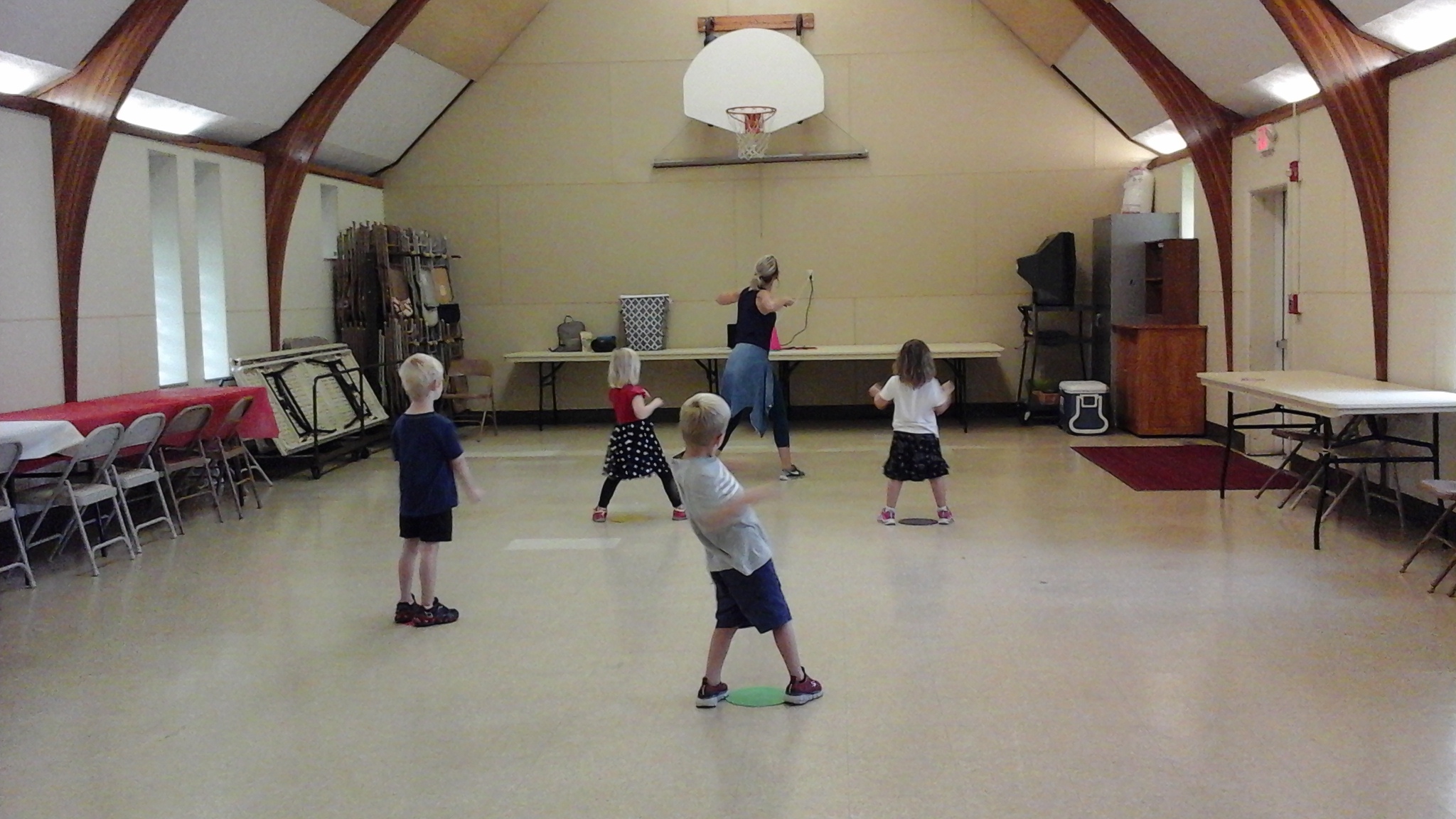
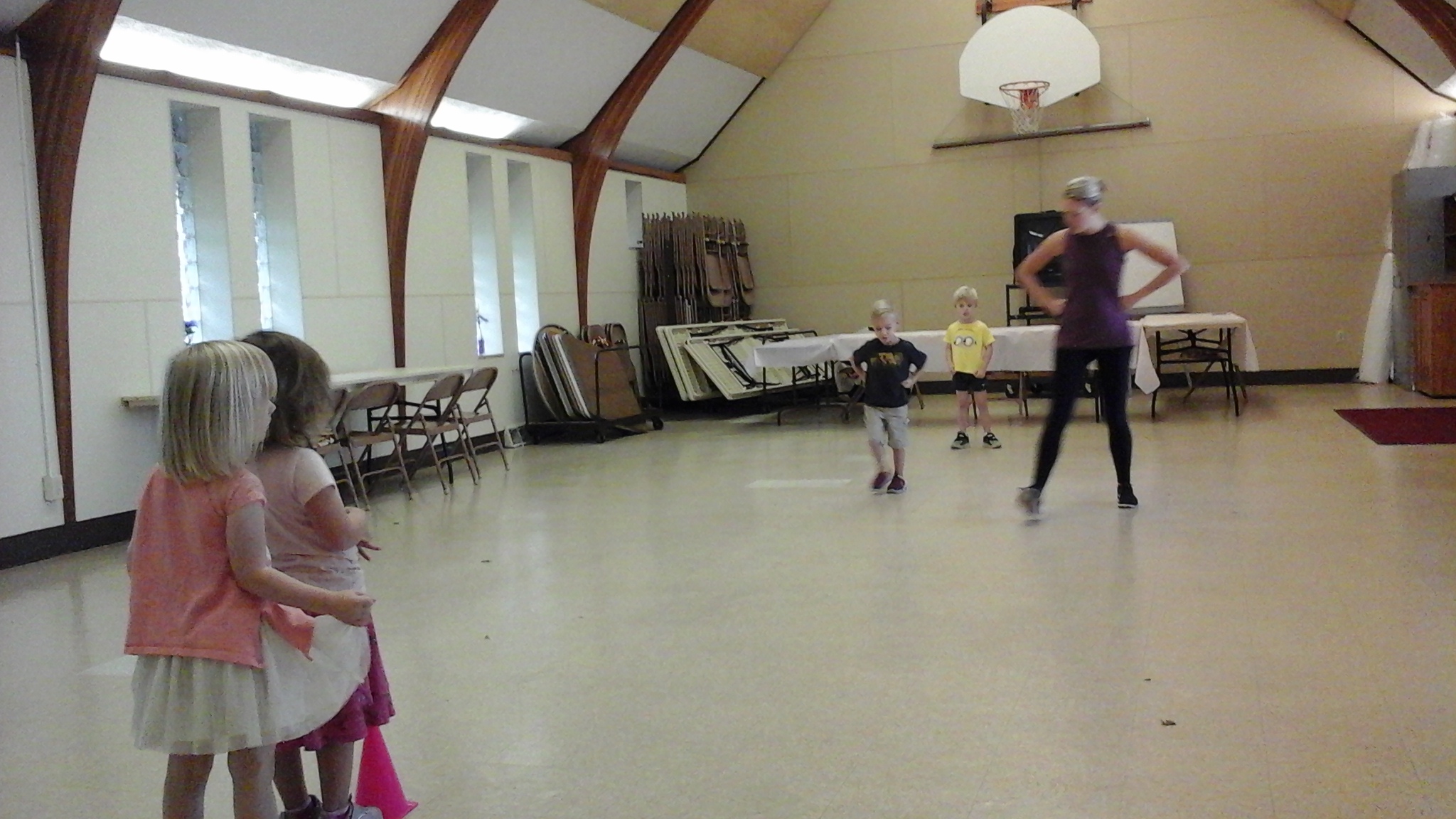
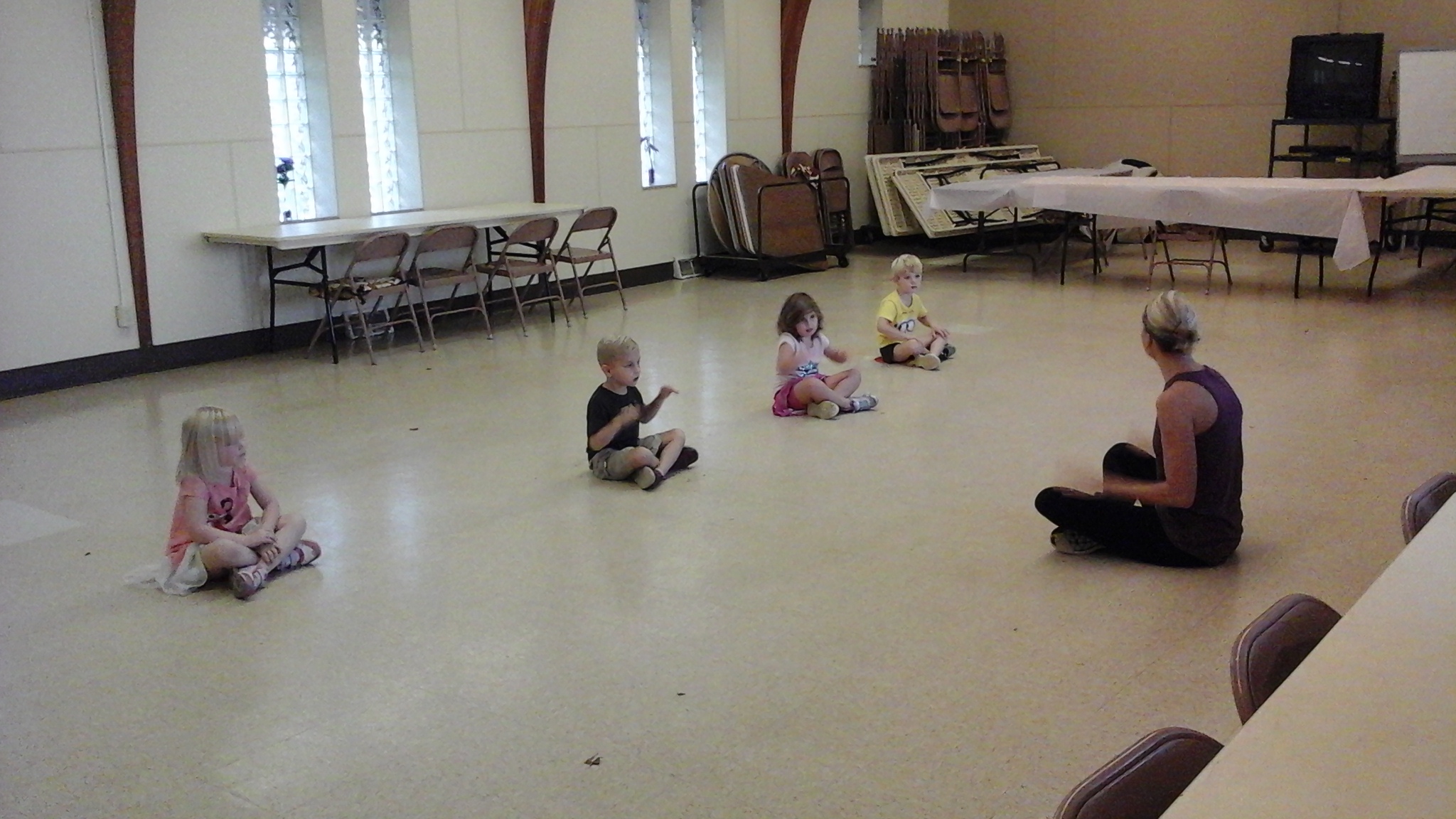
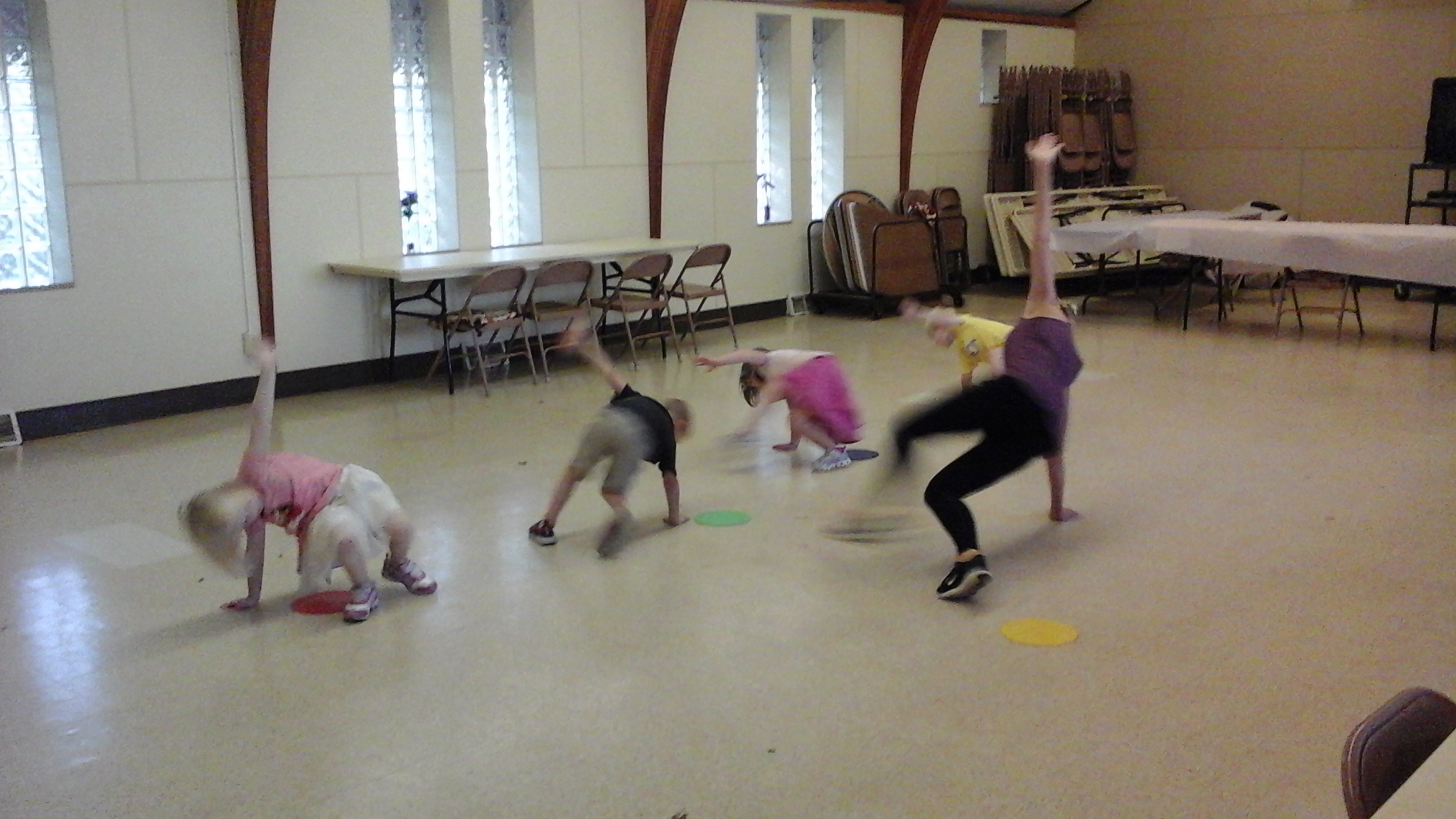
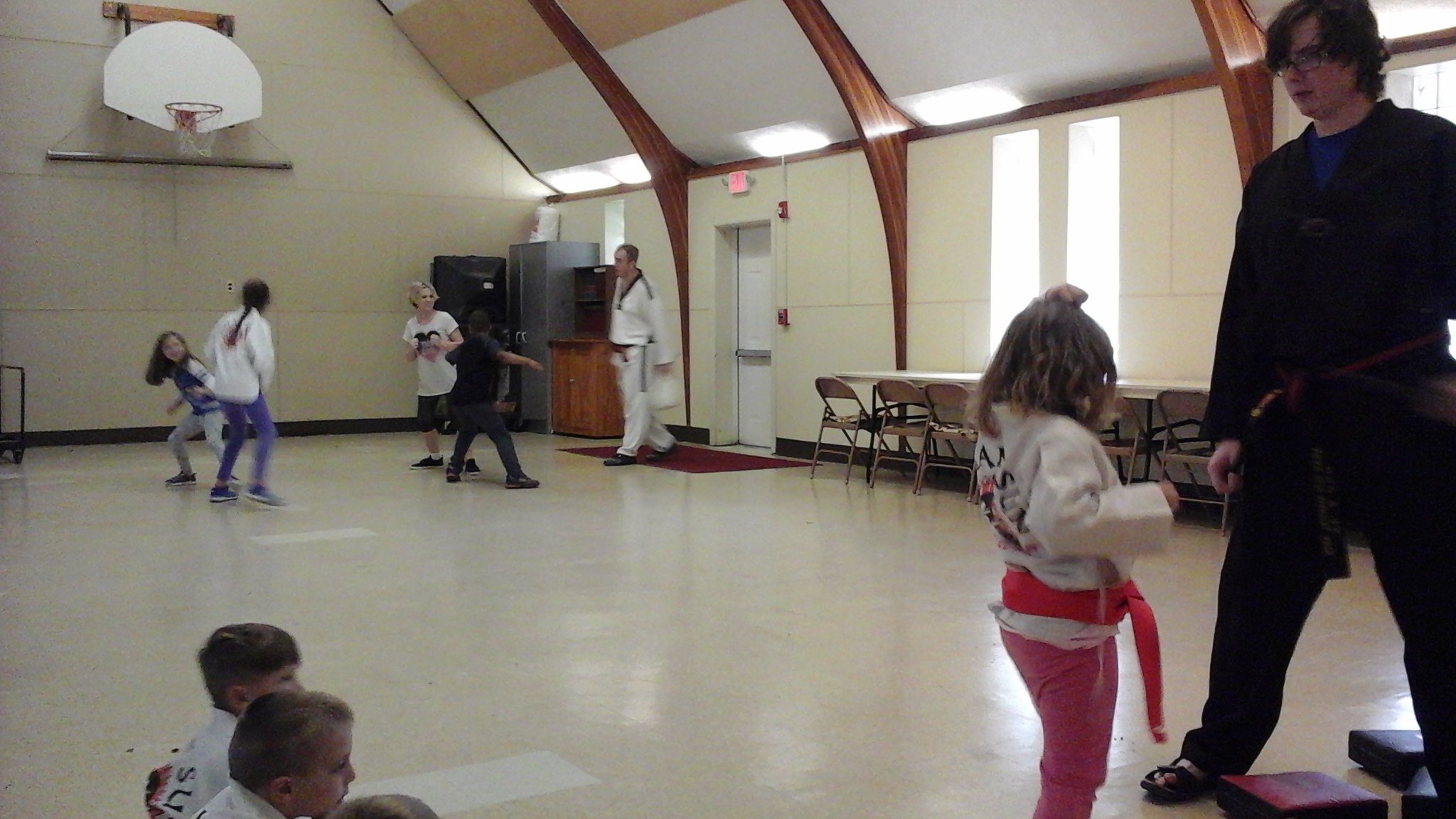
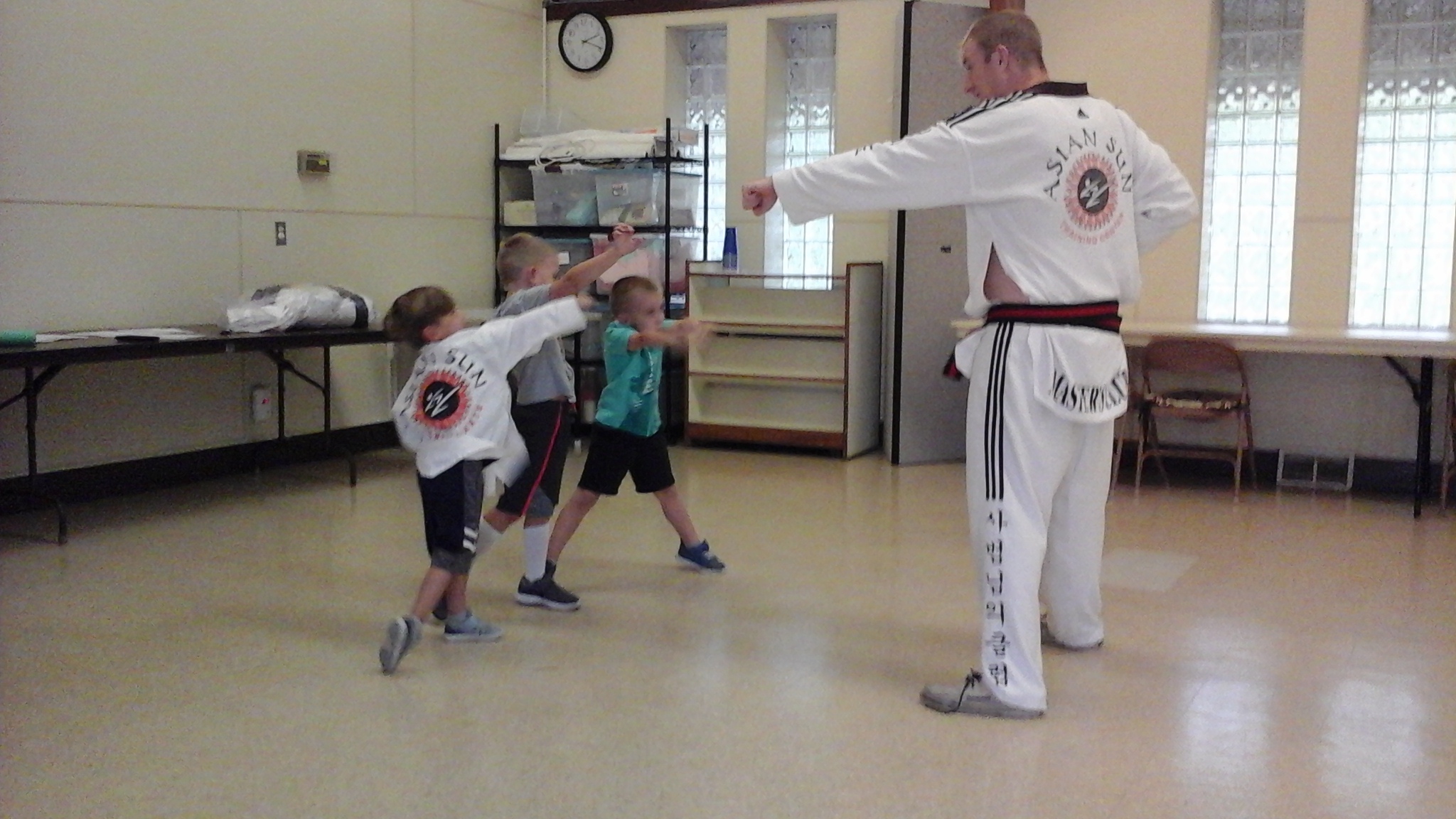
We have had a blast in taekwondo during the month of September! We played a lot of games that helps to improve our sense of balance and requires us to multitask. One of these games is called Ninja Rocks. To play this game, you have to walk across the ninja rocks (punching targets) and you also have to watch for the ninja sword so you can block it when it tries to tap you on the head.
We also took time to practice our forms which we will have to learn for our belt tests.
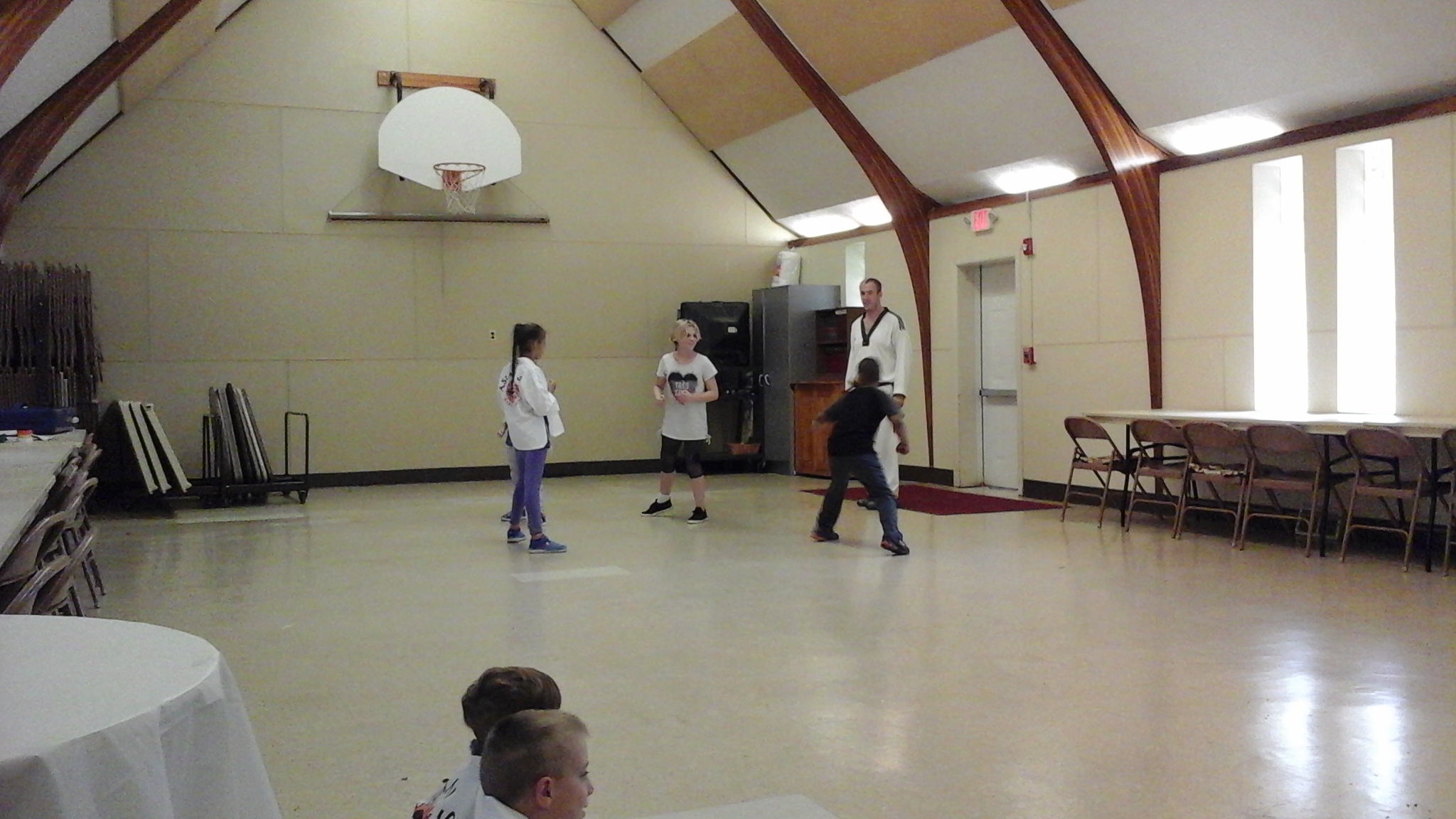
The elementary students had the opportunity to challenge each other in a game of Ninja Tag. In this game, students are paired up and they each get two lunges to try and tag their partner on the arm.
Ninja Sneak is another game we played this month. This game is played much like Red Light,Green Light however everyone has to be as silent as possible because if the instructor hears you, you have to go all the way back to the beginning.
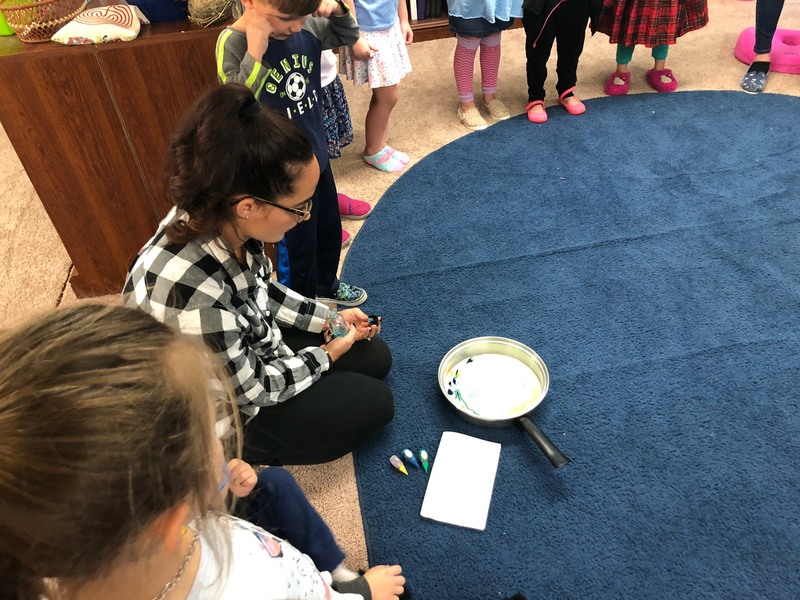
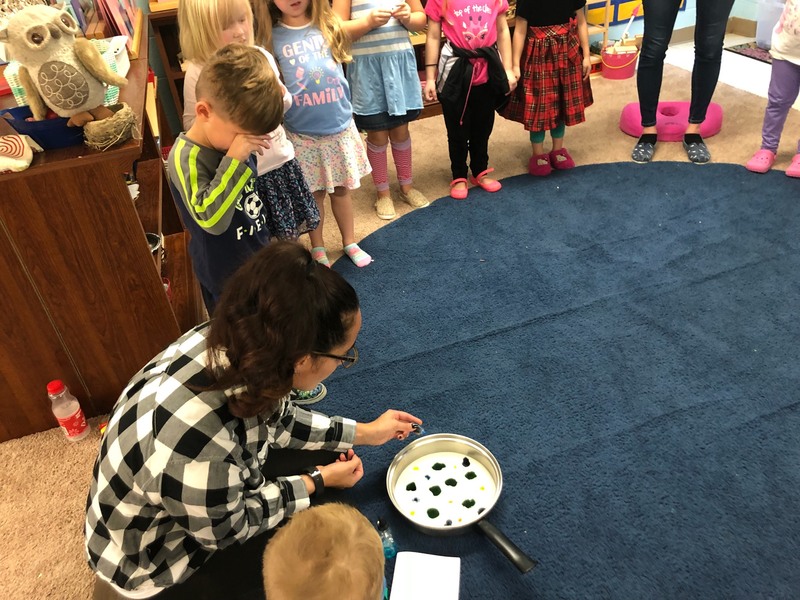
Tie Dye Milk Experiment: First we filled a pan up with milk. Then, we put drops of food coloring on it. The children observed how the food coloring stayed in place, because food coloring is less dense than the milk. Then, we put a drop of dish soap on it. Once we put a drop of dish soap on it the surface tension was reduced. As the dish soap spread it attracted the food coloring, this is because dish soap is a “degreaser” and the molecules in it were attacking the fat in the milk. This is what caused motion and created the swirling of the colors.
Changing of the Leaves: We took leaves from two different tree’s and placed them in rubbing alcohol then created energy using hot water. We placed the leaves in the hot water to separate the colors. At first we saw green because the chlorophyll in the leaves gives them their green color, and it is so dominant that it hides the other colors in the leaves. However, in the fall the chlorophyll in the leaves breaks down allowing the other colors to finally shine through and show their beautiful reds, yellows, and oranges.
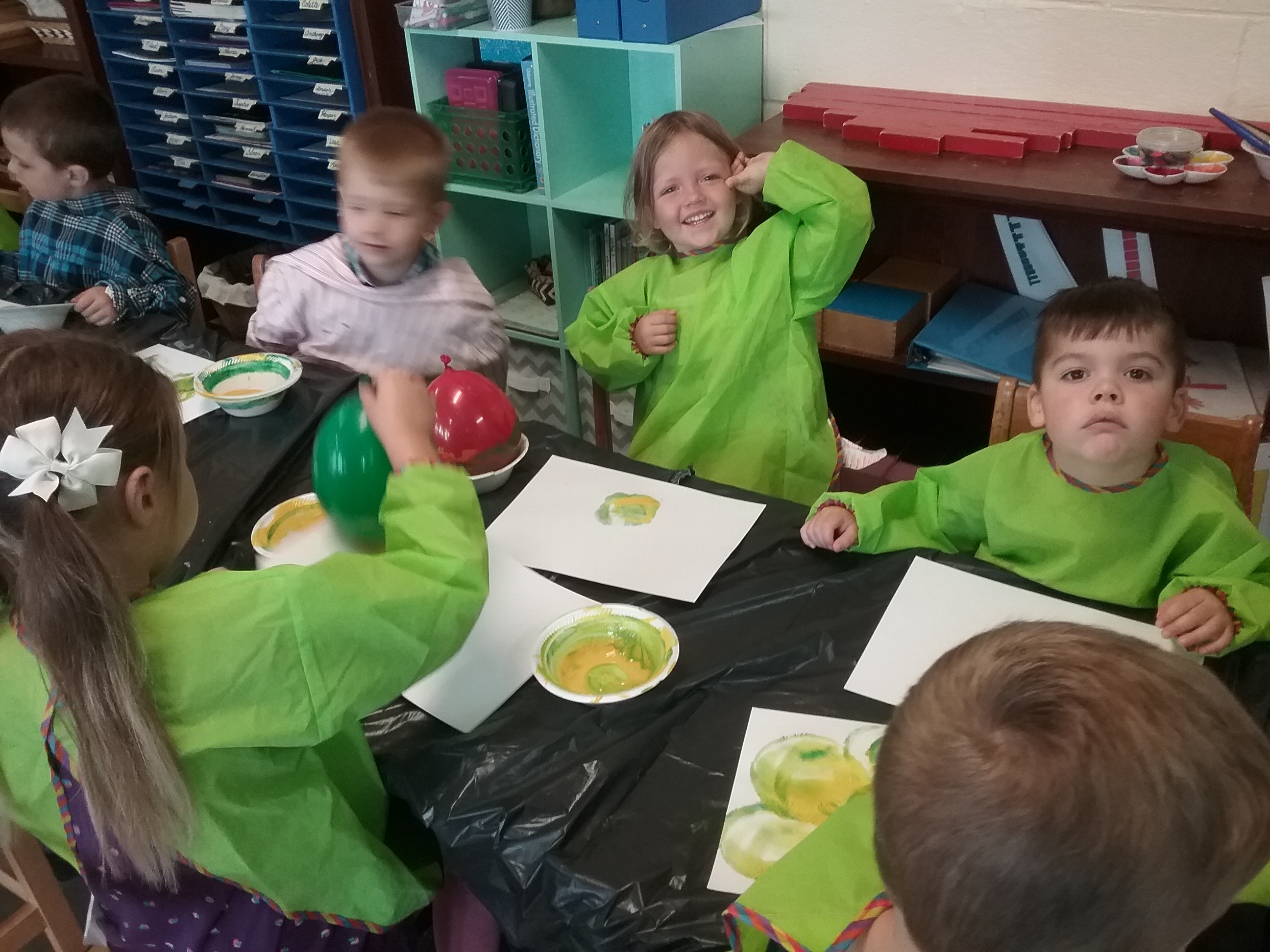
We started off the school year studying artist Wayne Thiebaud. He is a modern American artist most known for his beautiful paintings of cakes, doughnuts, and ice cream cones. I had the students paint ice cream scoops in Primary Colors and they learned how to blend white to each ice cream scoop so to make them look three dimensional and realistic as Wayne Thiebaud did in his paintings. Next they painted popsicles while learning about Secondary Colors. We used a technique called crayon resist to create a pattern on the popsicle and then used watercolors to paint over the crayon. They have had such fun painting and getting messy as artists are required to!
Welcome back to another fantastic year of science with Mr. John! Mr. John does science every Thursday for our classes at the Cuyahoga Falls site. He prepares fun and interactive science experiments that students enjoy so much. After each class your student will come home with an outline of the experiment, your child’s hypothesis and an explanation of what us happening during the experiment.
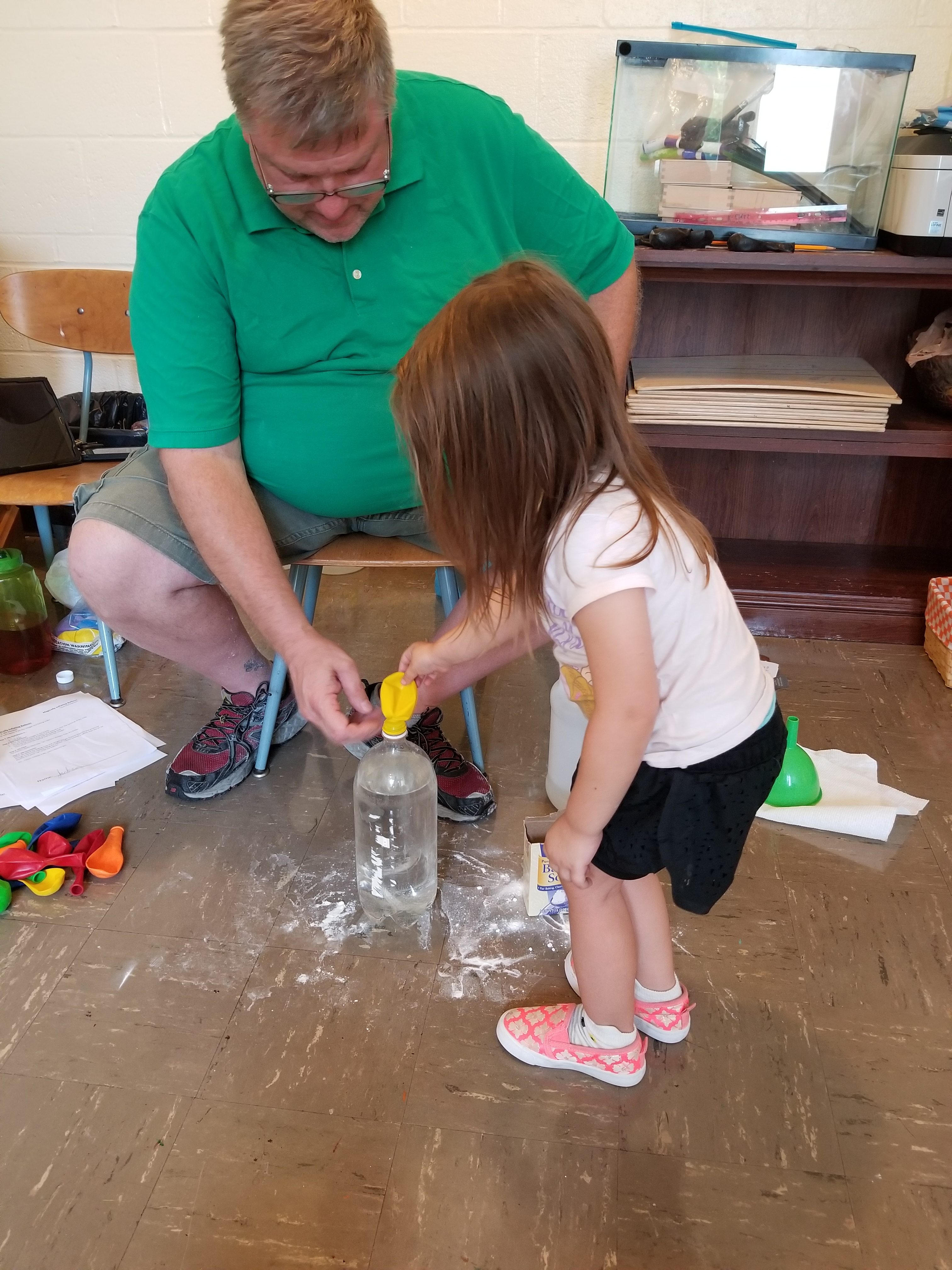
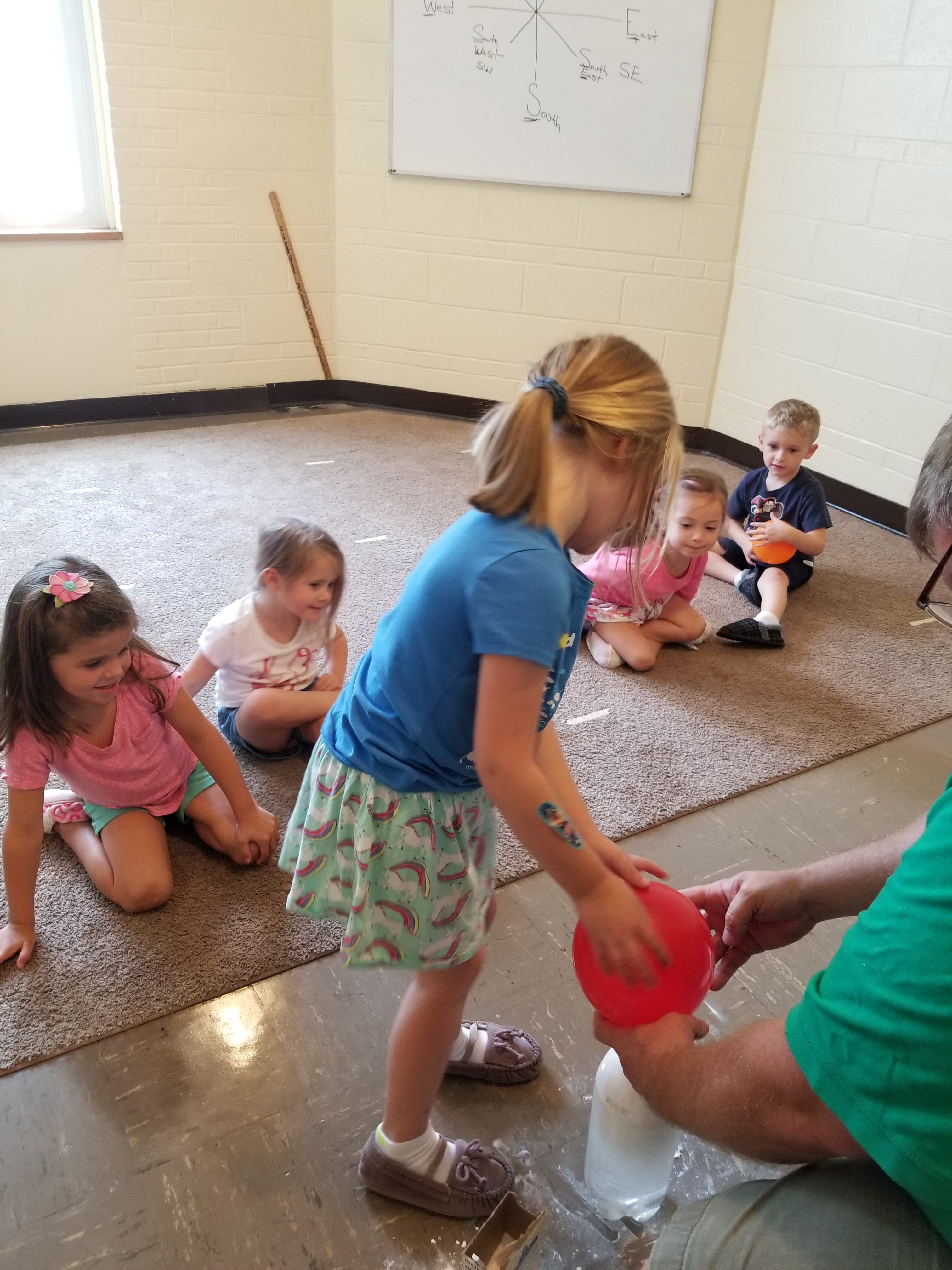
Here a student is pouring baking soda into a balloon. Each student had the opportunity to fill their own balloon during this experiment!Here the student is emptying the baking soda in her balloon into a 2liter bottle that is full of white vinegar. The end of the balloon is securely around the opening of the bottle.Here a student is helping Mr. John as her balloon begins to expand after the baking soda is combined with the vinegar in the bottle. Why is the balloon filling up and expanding?
The science, behind this balloon baking soda experiment, is the chemical reaction between the base {baking soda} and the acid {vinegar}. When the two ingredients mix together the balloon baking soda experiment gets it’s lift! The balloon is filling with the gas produced from the two ingredients is carbon dioxide or CO2.Carbon dioxide is Mr. John’s favorite gas.
Week 2:
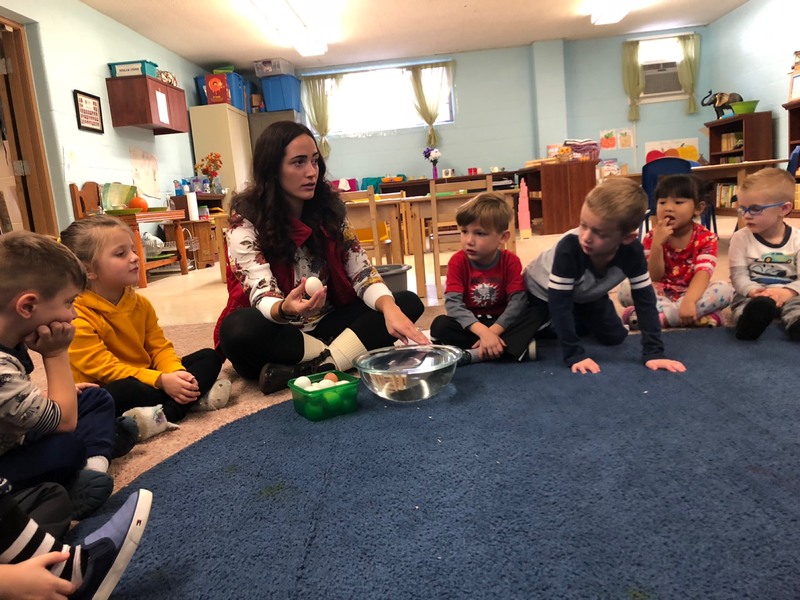
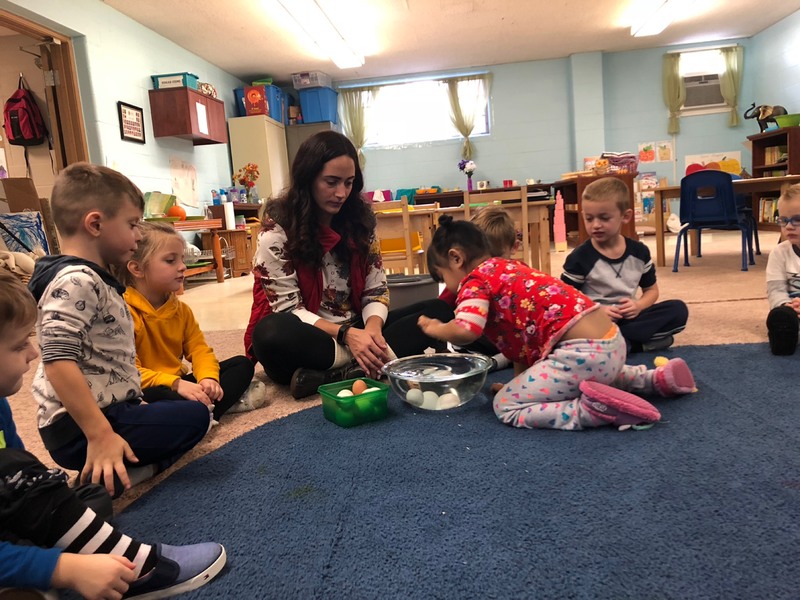
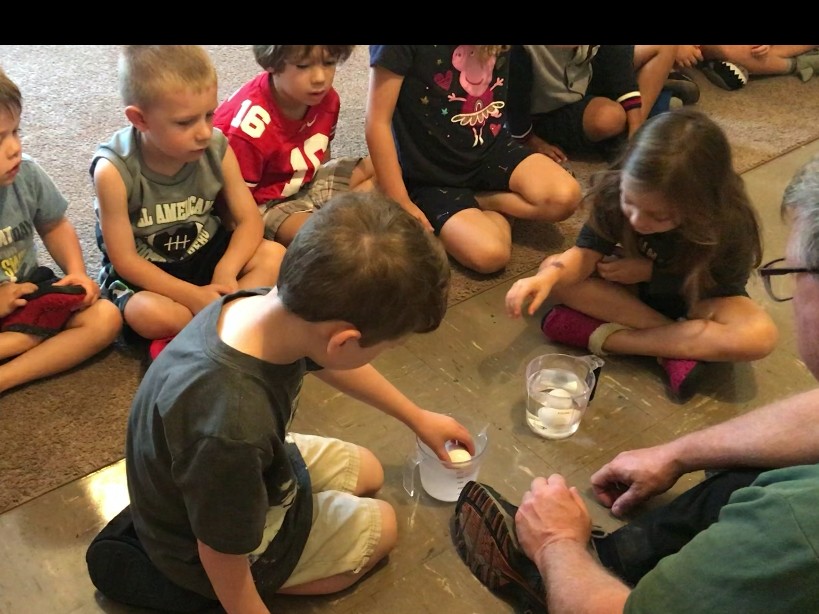
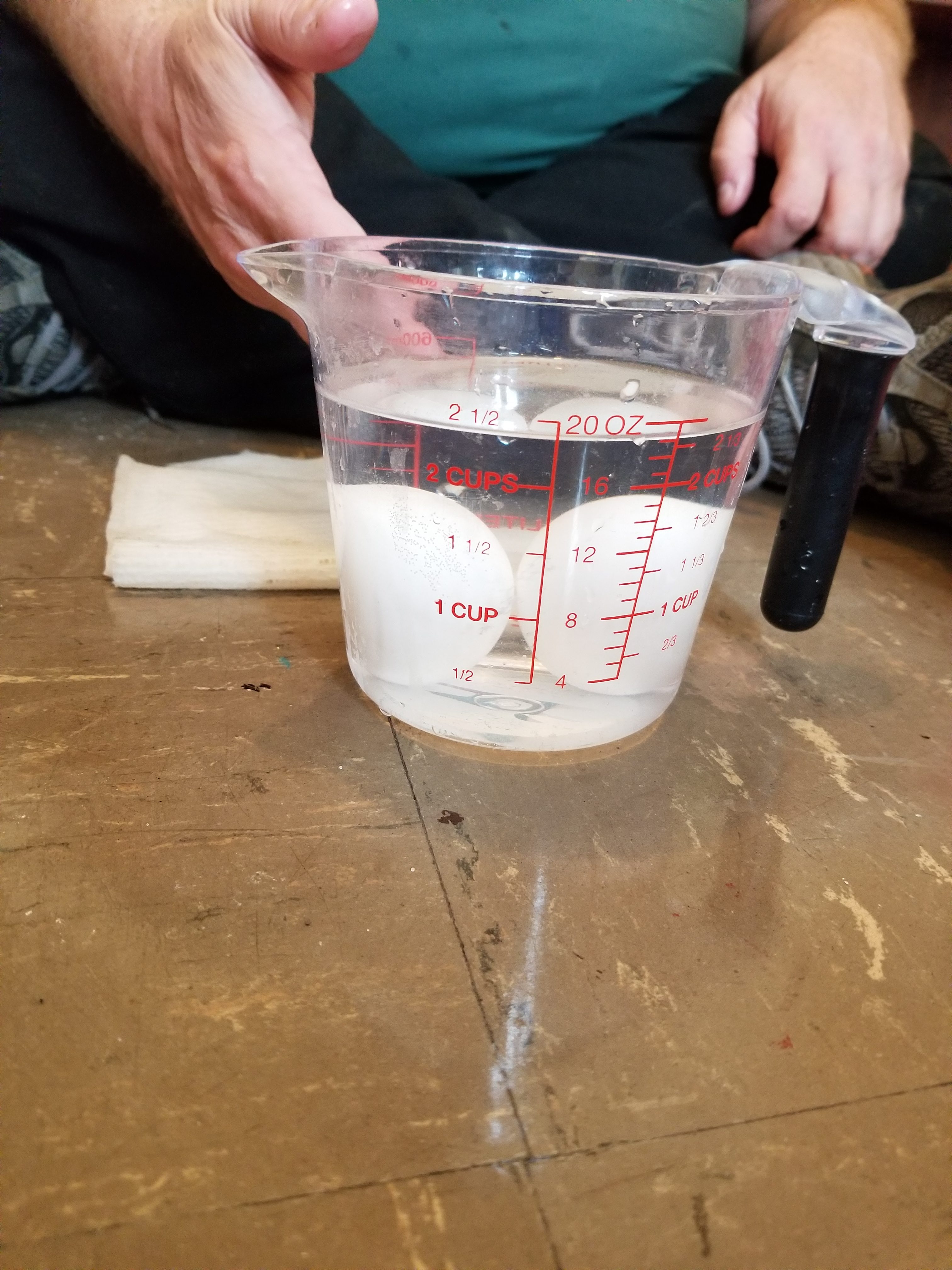
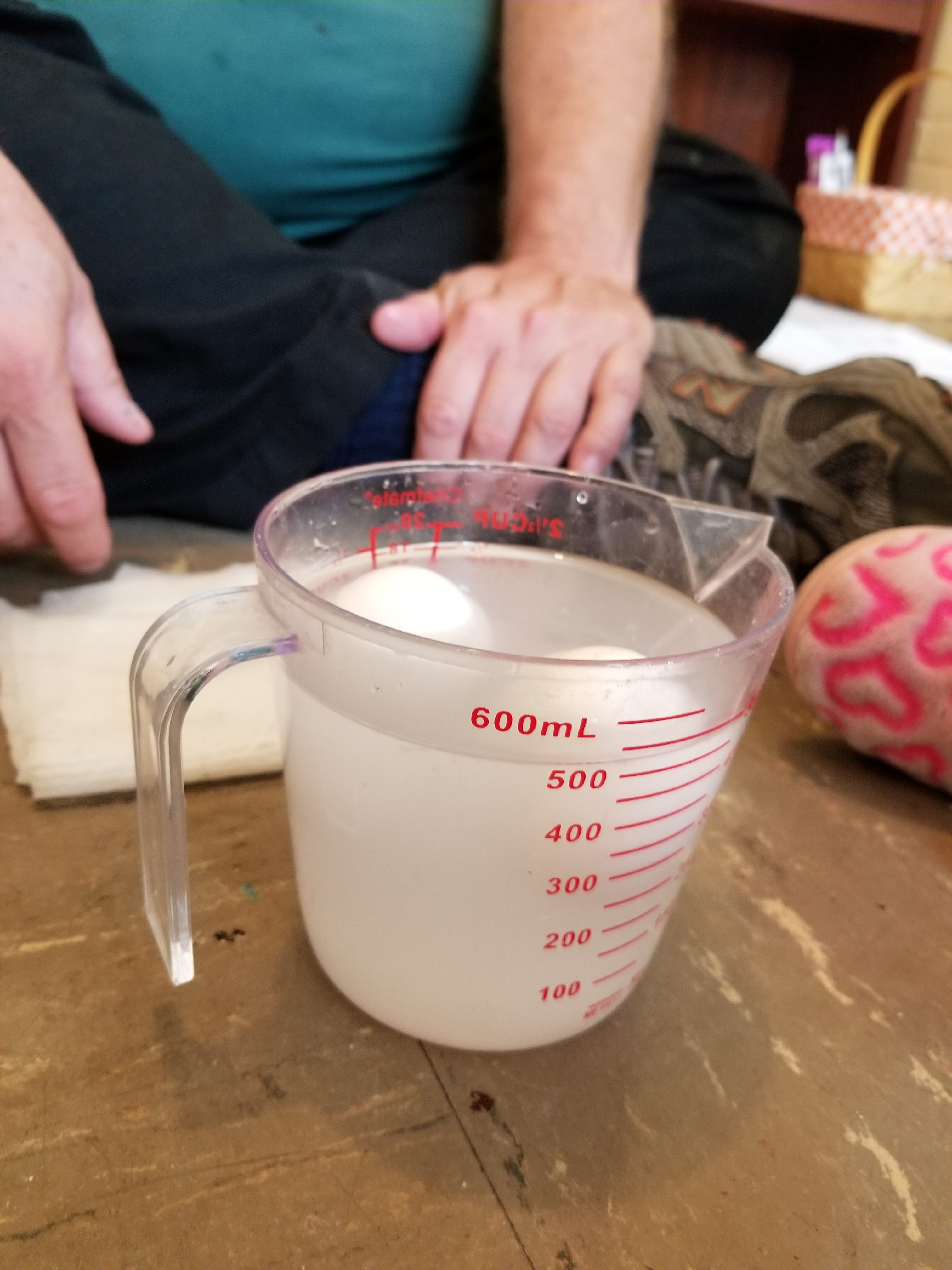
Here two students are putting eggs into cups of water. One cup has plain water and the other is salt water.Here the two eggs are in fresh water. They are at the bottom of the cup.Here the two eggs are in salt water. They are floating at the top.
If you put an egg in a cup of tap water, it will sink to the bottom. Why is this?
Because the density of the egg is higher than the density of tap water, so it sinks. Density is the mass of a material per unit volume. For example, the density of freshwater under standard conditions is approximately one gram per cubic centimeter.
But, if you add enough salt to the water, the egg will actually float back up to the surface! Adding salt to the water increases the density of the solution because the salt increases the mass without changing the volume very much.
When enough salt is added to the water, the saltwater solution’s density becomes higher than the egg’s, so the egg will then float! The ability of something, like the egg, to float in water or some other liquid is known as buoyancy.
Week 3
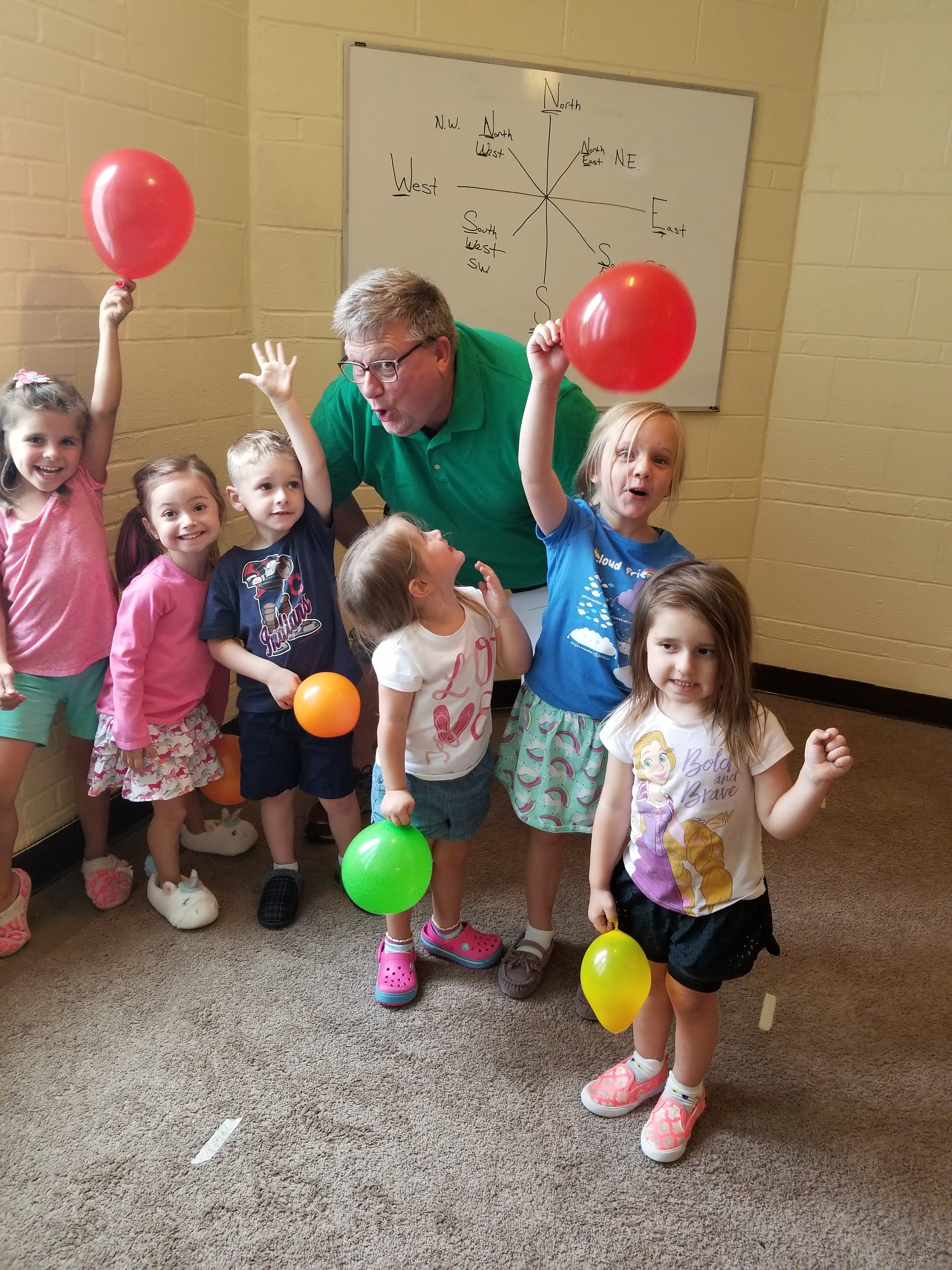
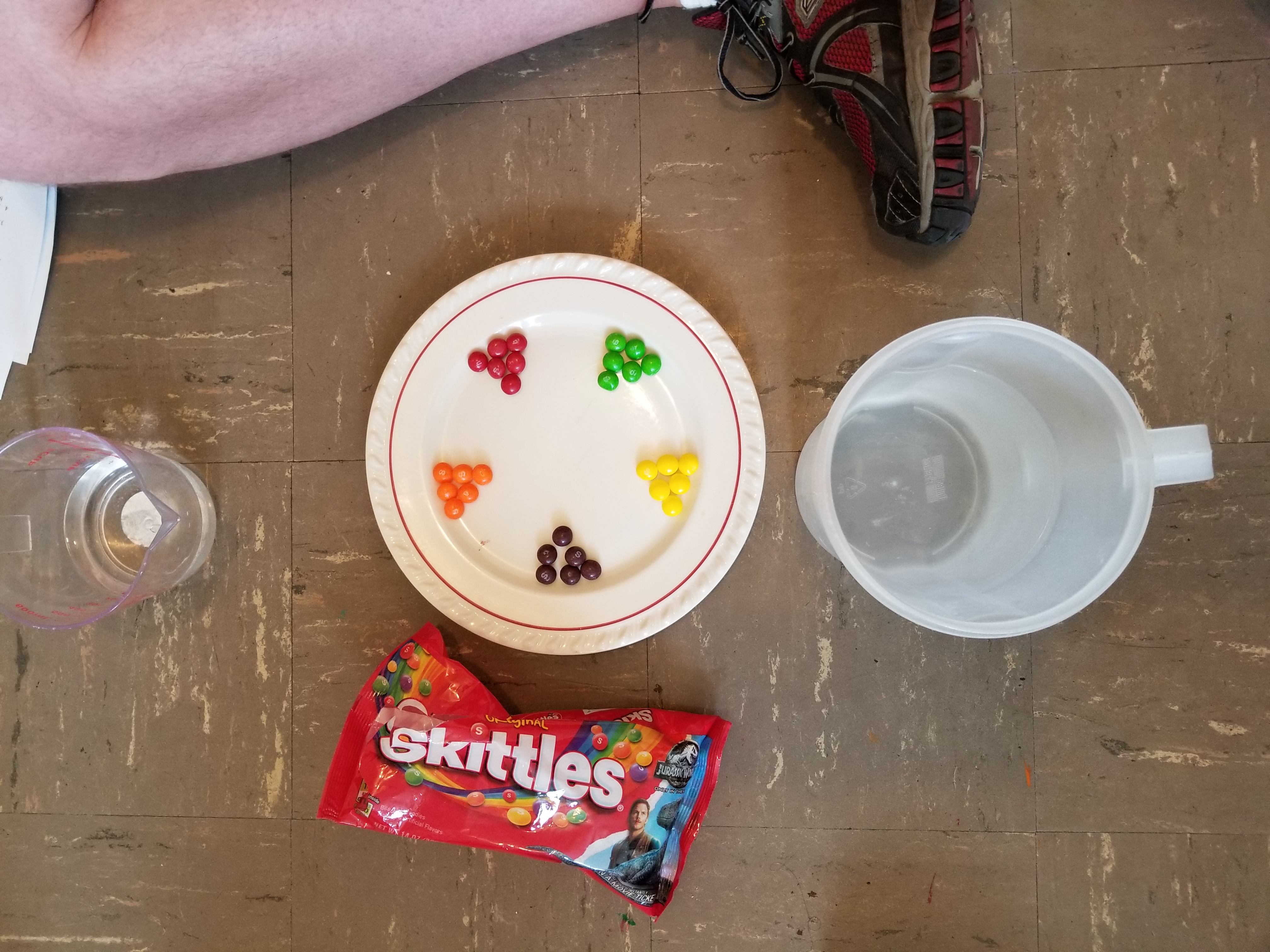
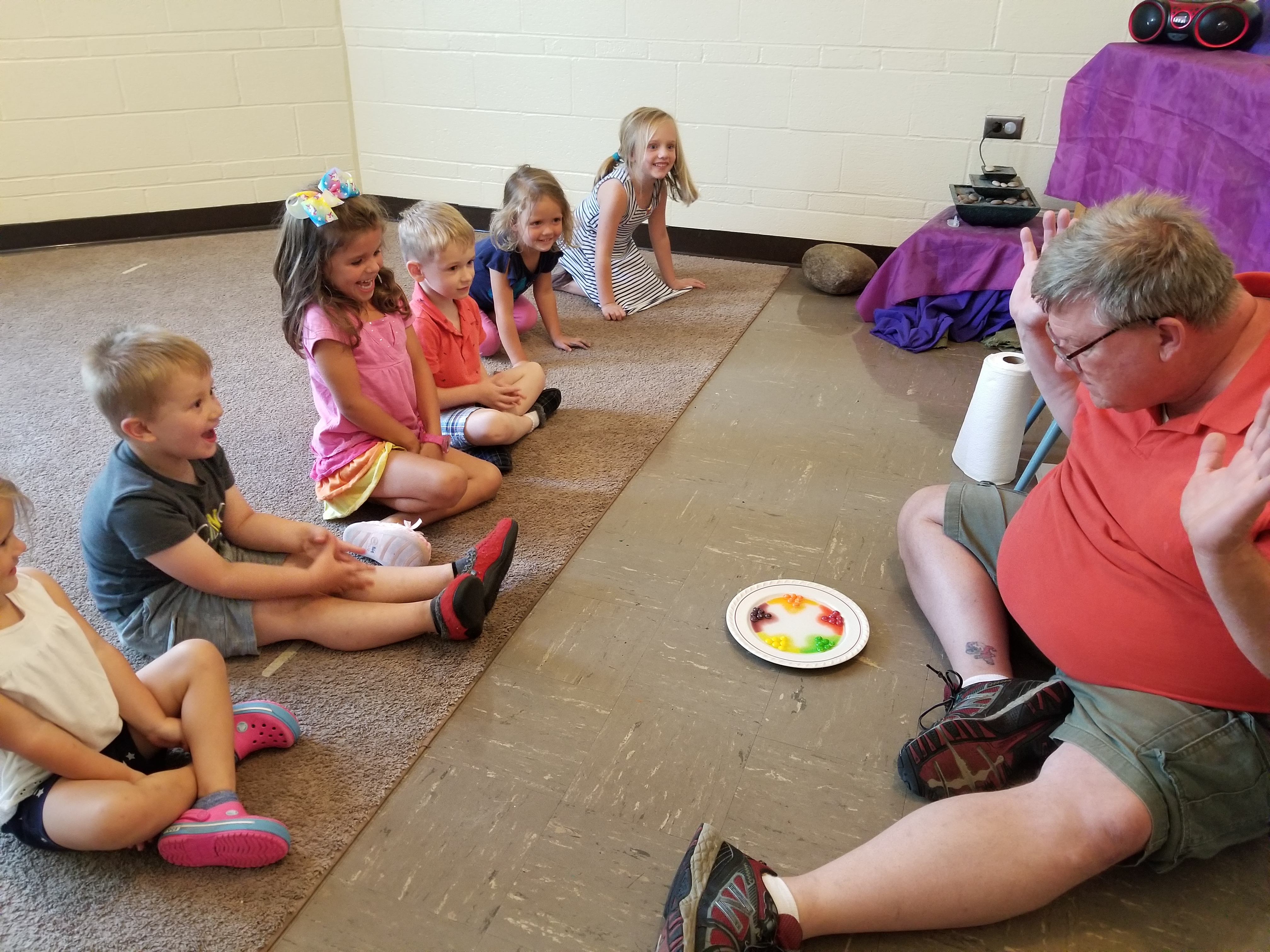
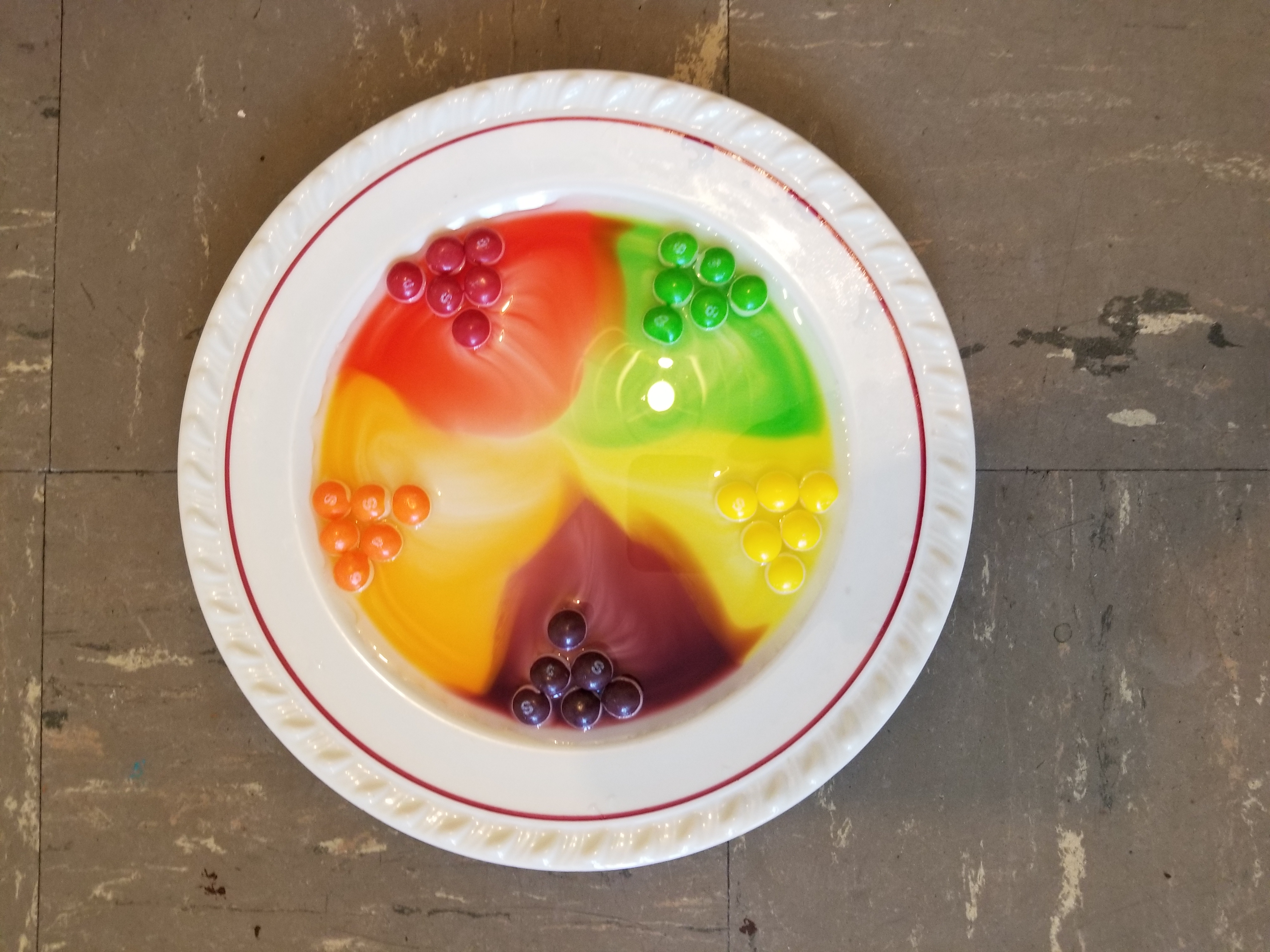
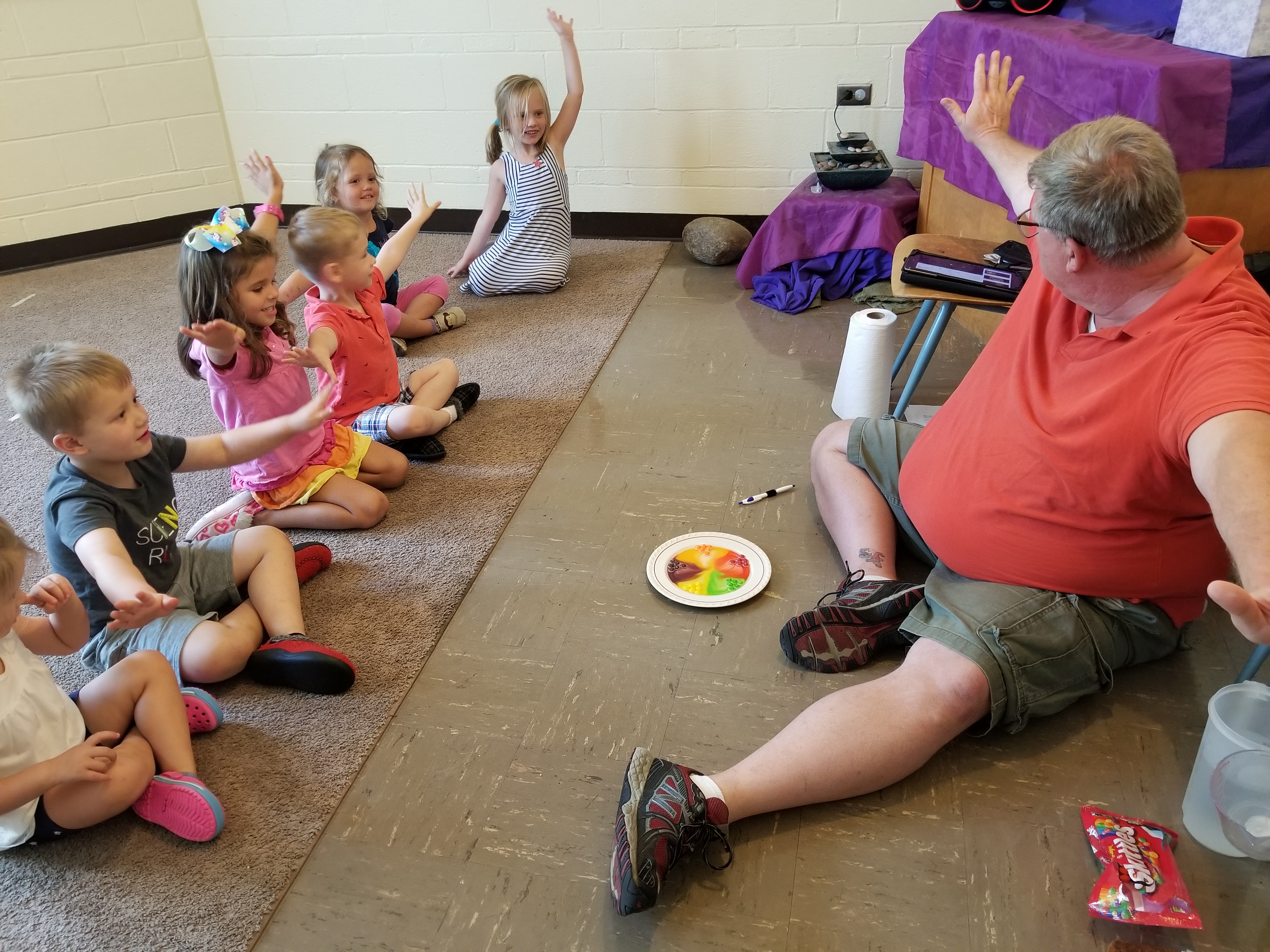
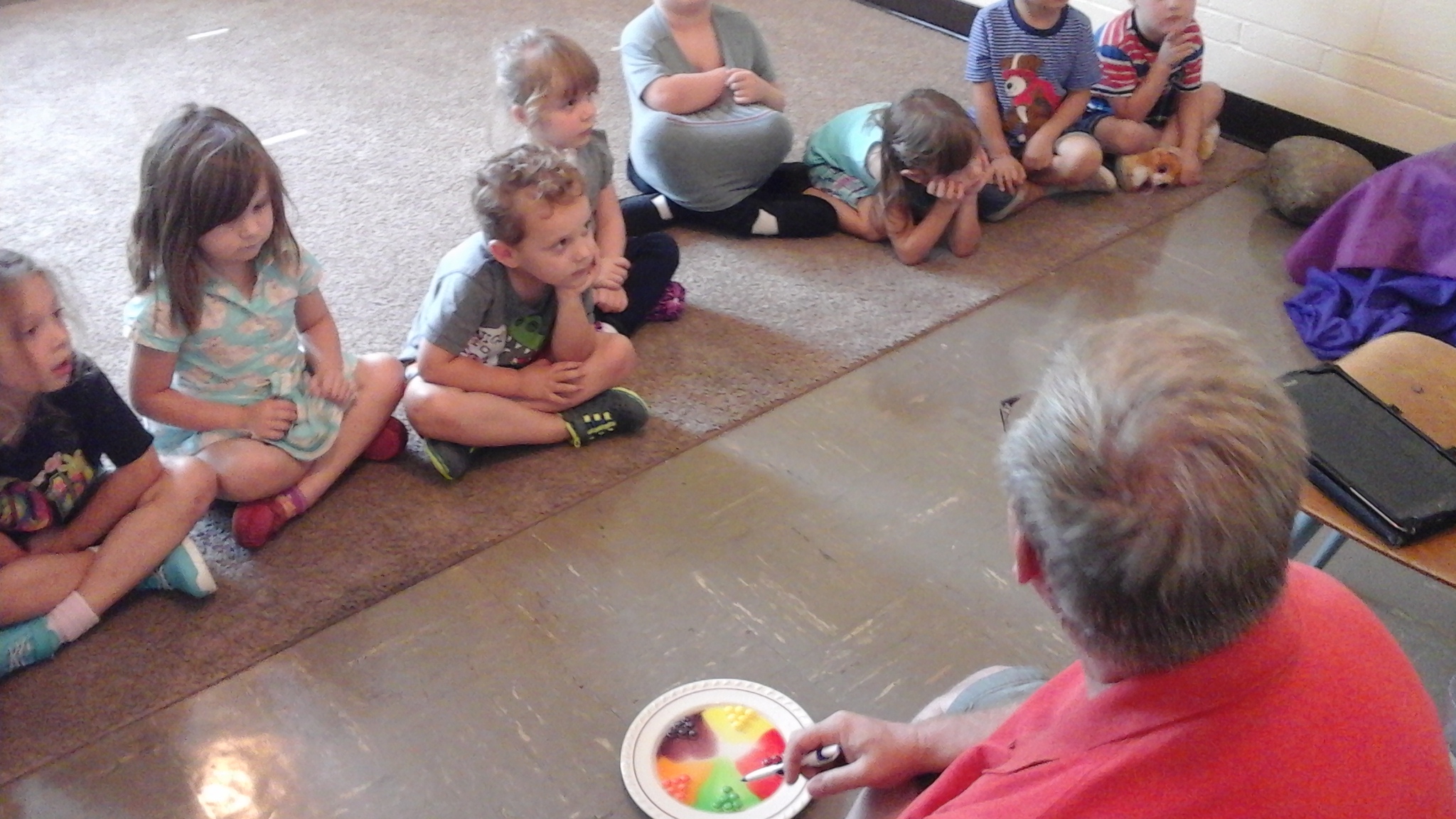
In week three, all Mr.John needed was water, a plate and SKITTLES! Only 3 materials needed for this experiment.Mr. John had arranged the skittles by color on the plate. Then he poured water on them. At first, nothing happened. Then all our friends began to point because the water started to change!The color on the skittles began to mix into the surrounding water. Noticenthough, that none of the colored water appears to be mixing. Why is that?Mr. John explained that each skittlen is covered with the coloring and a itty bit of wax. The wax creates the barriers between the colors. Once the wax starts to mix with the water, the colors will eventually all blend together. Here is Mr. John and friends pretending to be the wax, keeping the other colors away.So bummed that we didn’t get to eat the skittles!
Week 4
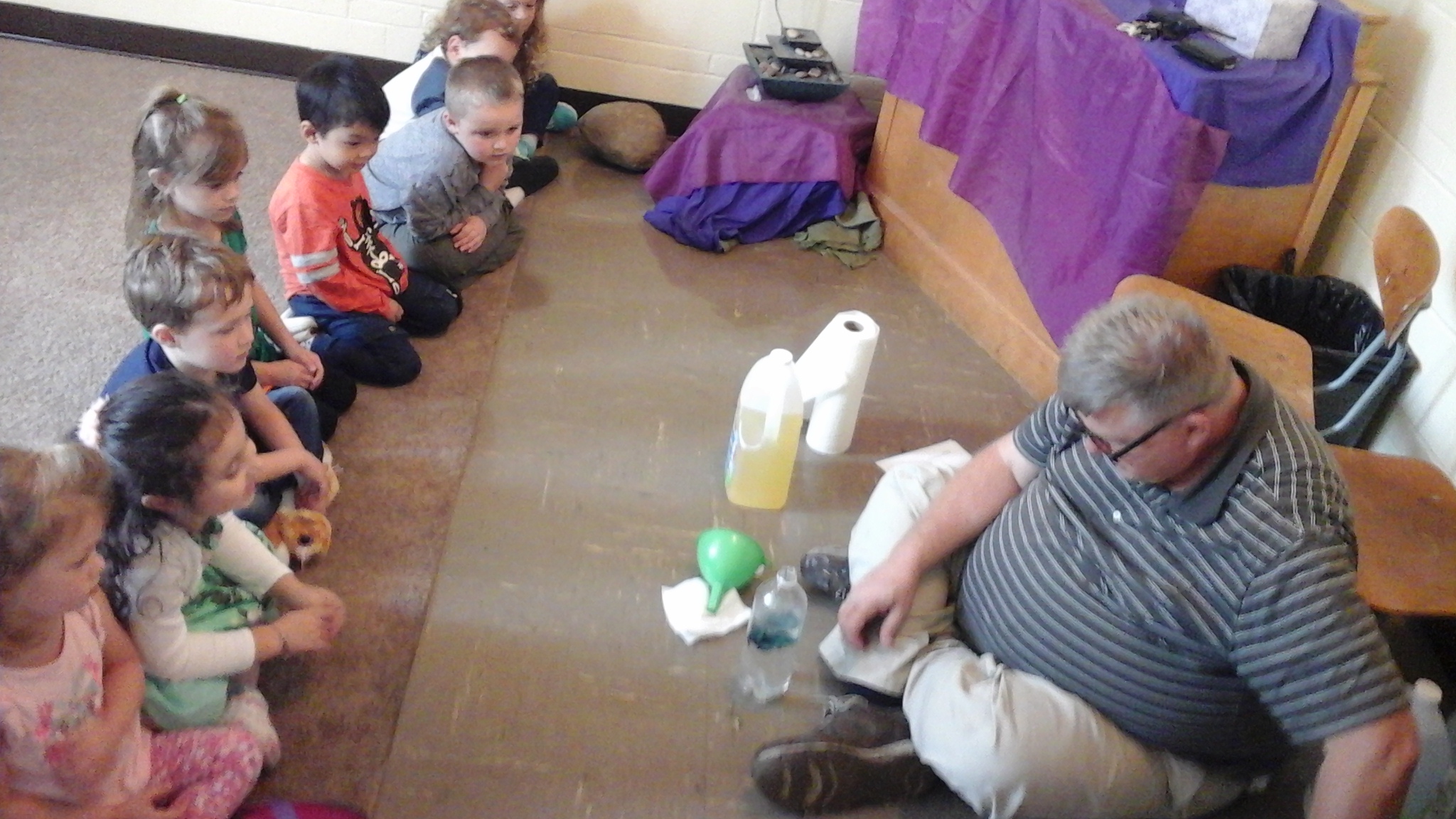
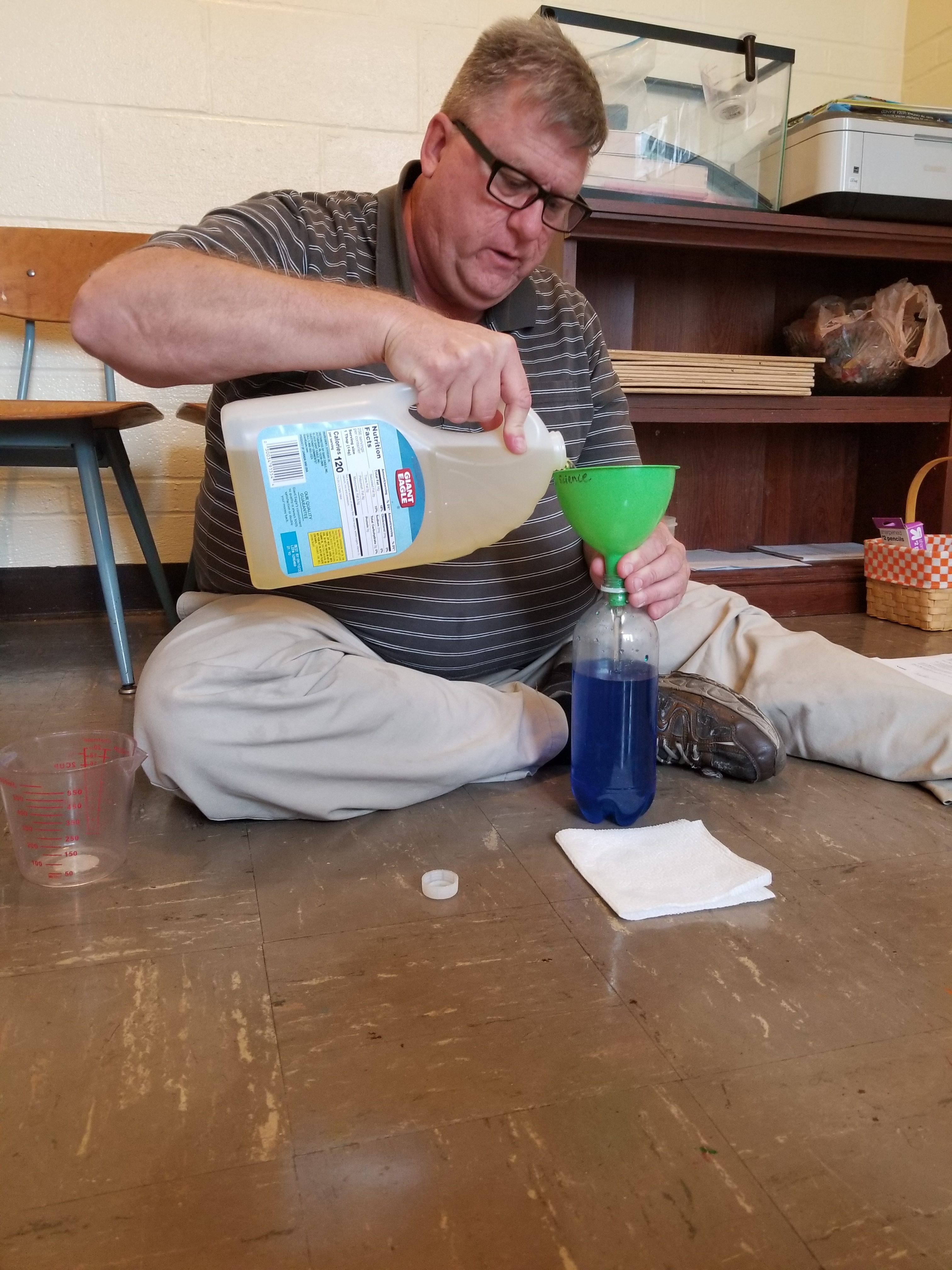
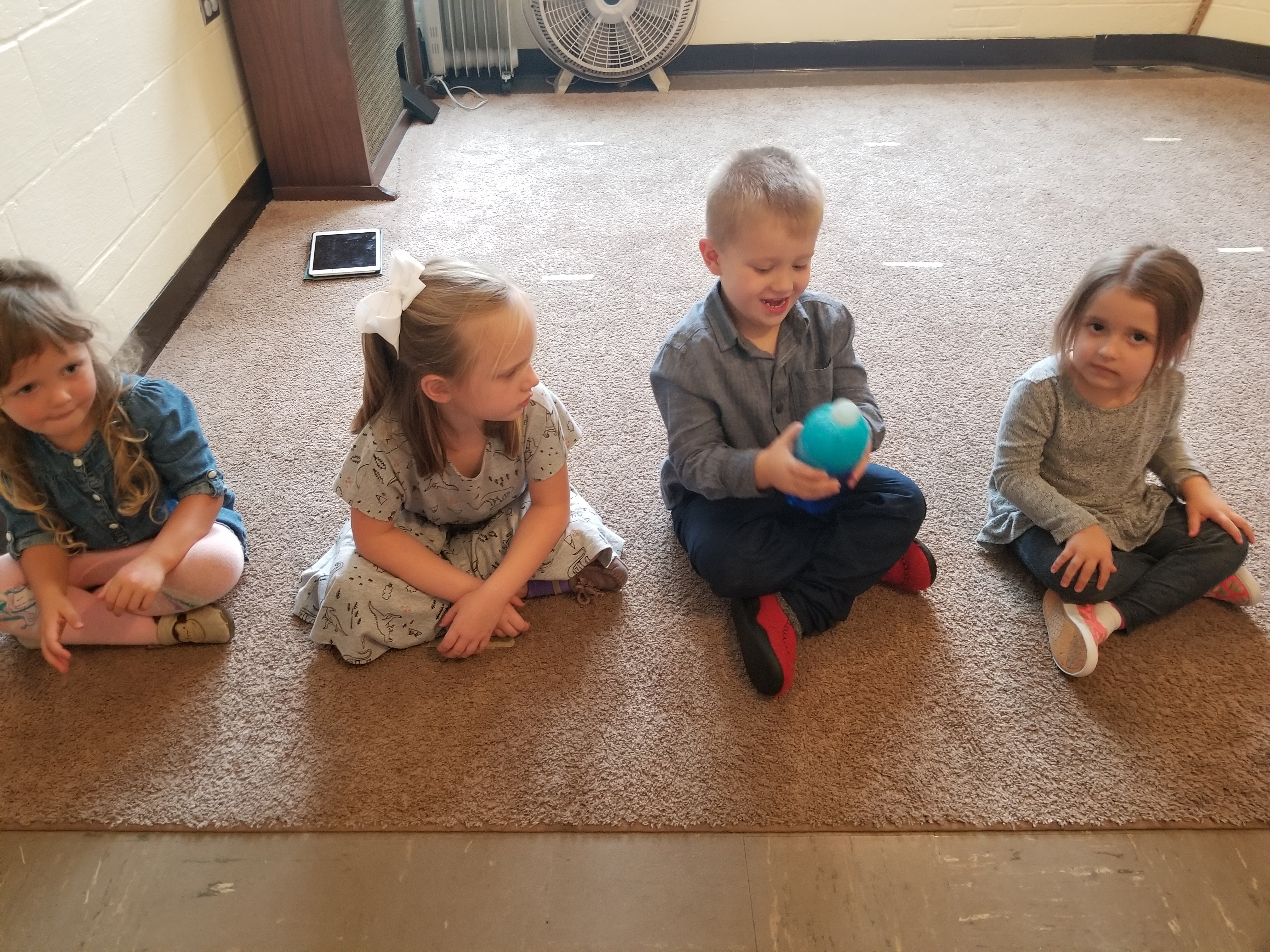
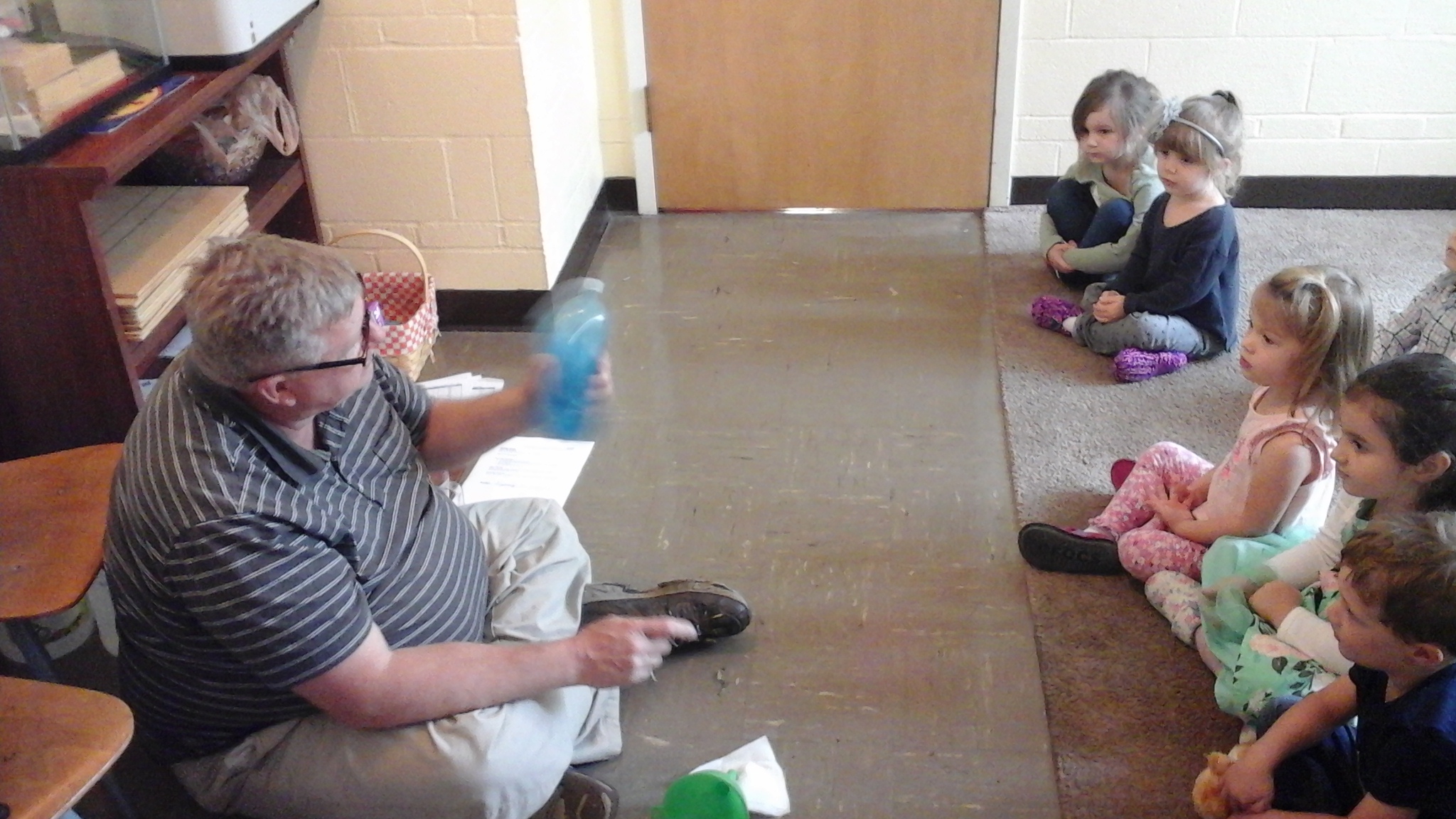
In week 4, Mr. John used oil, water, food coloring, an empty plastic bottle and a funnel. Have you noticed that he tends to use everyday household materials for a majority of his experiments?
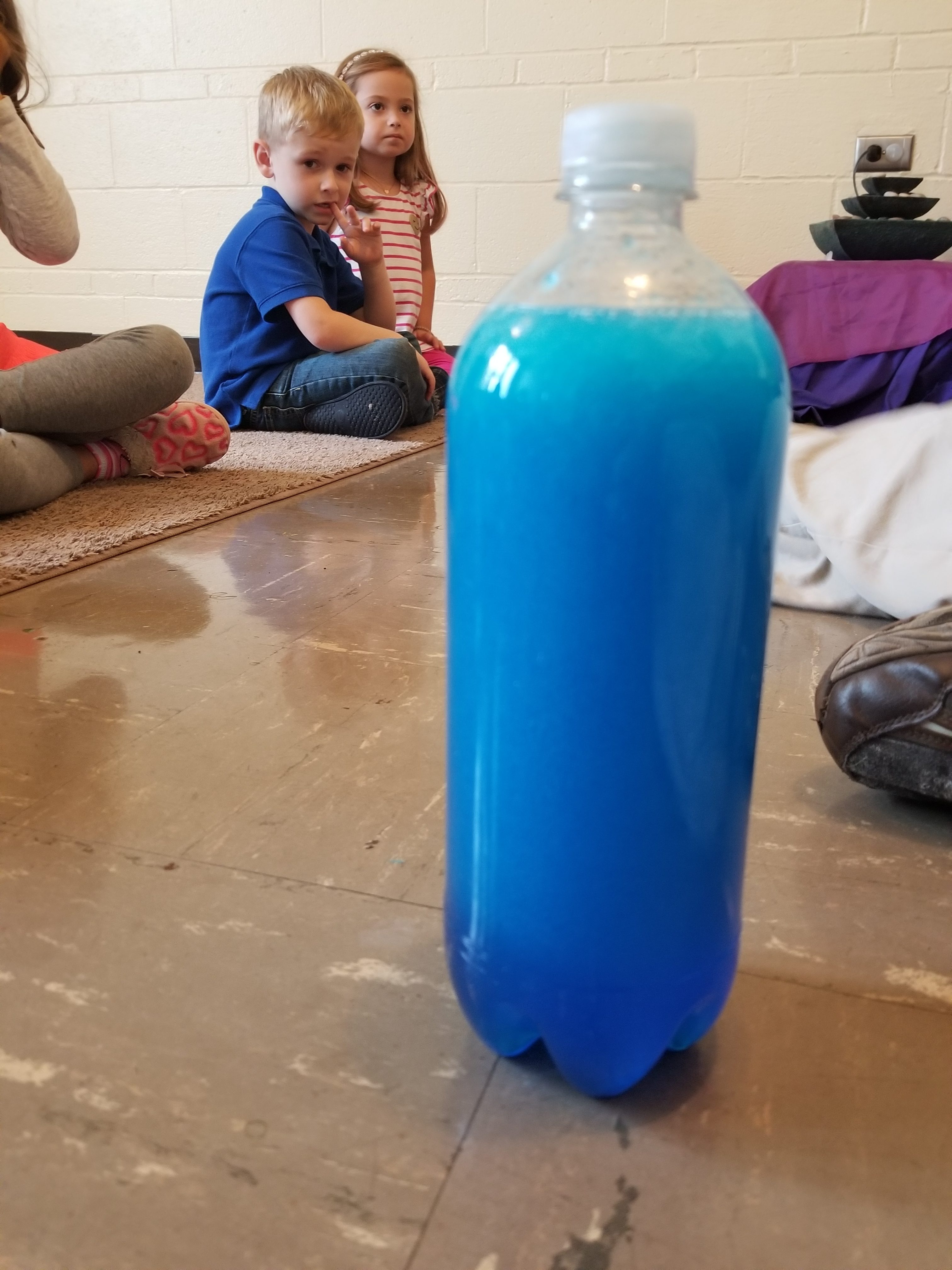
Mr. John began with making blue water in the bottle using the food dye. Then he filled the rest of the bottle with the oil.
Then Mr. John had each student shake the bottle to mix all the oil and water. At first it seemed to work.
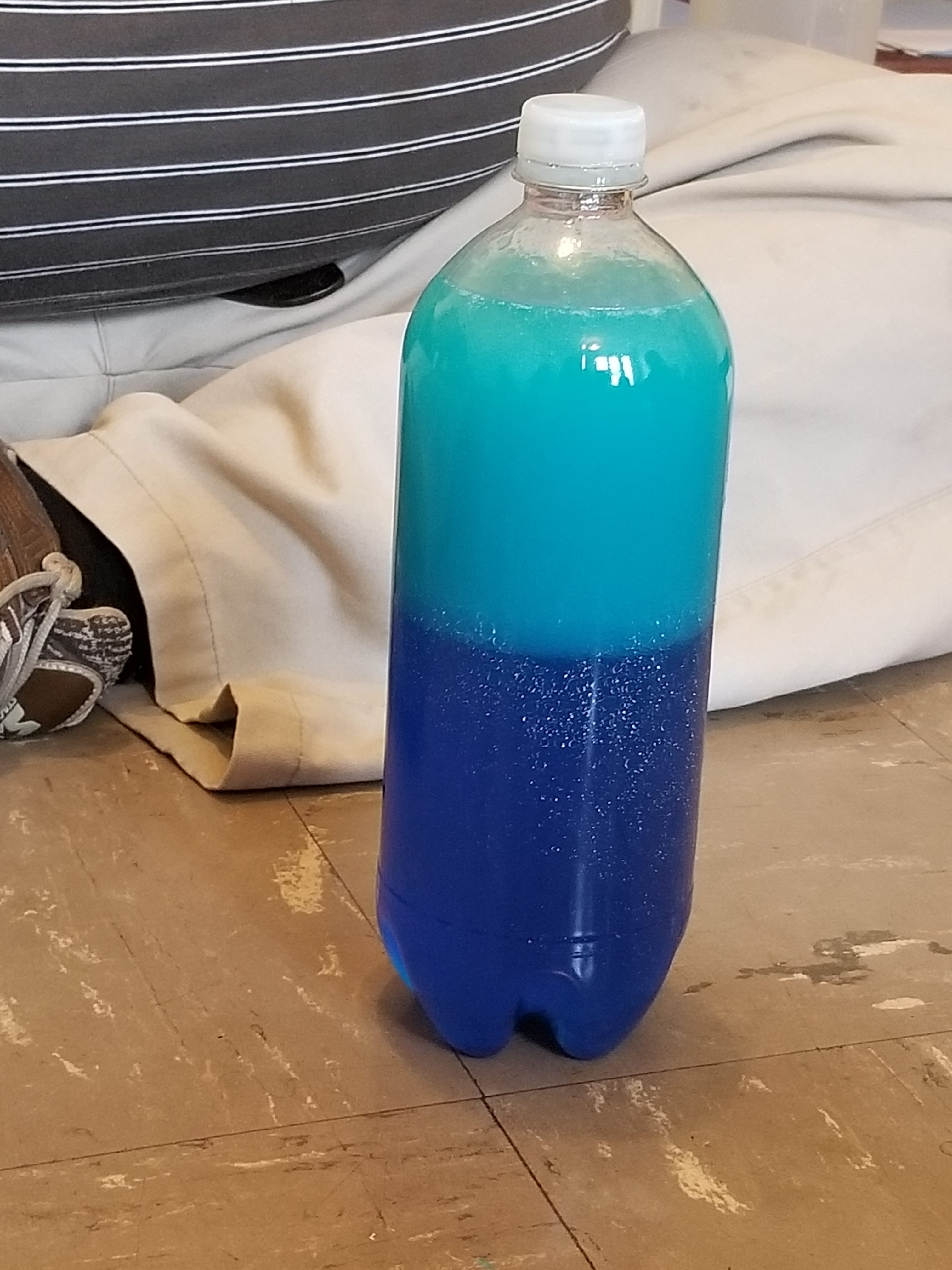
Mr. John set the bottle down and everyone had their eyes glued to the bottle. The oil and water were separating!
Why does the water not mix with the oil?
Oil is less dense than water. Given the variance in densities the two liquids cannot mix.
Oil and water also do not mix because water molecules are more attracted to each other than to oil molecules.
Shake shake Shake! Shake your bottle!
I hope you enjoyed this month of activities. Don’t forget to check your student’s folder on Thursdays for the instructions for each experiment!